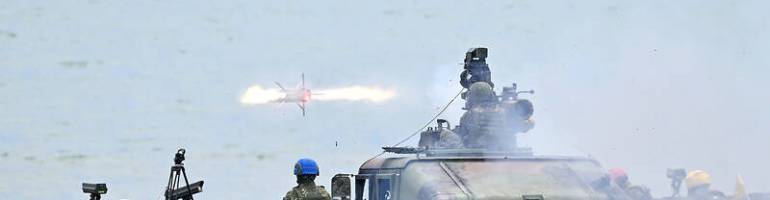

“US to deliver TOW-2B missiles this year. MORE FIREPOWER: The TOW-2B missiles can be used to attack tanks and bunkers, and destroy landing ships, which would greatly bolster the nation’s defense capabilities,” Taipei Times. Geostrategery, Taiwan Republic 台灣国, and world history classrooms. The TOW-2B anti-armor missiles are good examples of where the US and the Free World should begin to test the best ways to bring Taiwan Republic into the arms manufacturing supply chains and begin to bring larger Taiwanese military units to the US and allies, and rotate American and Japanese units into Taiwan, for training and coordination.
As luck would have it – President Tsai spent eight years repairing the severe damage done to Taiwan’s national security caused by the China KMT’s Ma and his defeatist surrender monkeys. So, there are many new weapon systems purchased by President Tsai for the US and allies to use as models for training, joint maneuvers, information sharing, and supply-chain/maintenance coordination. These new systems range from F-16Vs to M-1A2T, to shore-based Harpoons, to HIMARS, Javelins, Stingers, AMRAAMs, and Sidewinders.
The most important part of this report, and the most critical task of this new unusual civilian Minister of National Defense of Taiwan, is dealing with the Chinese Taipei entrenched national security establishment. One of the problems are national identity crisis within the military’s leadership. Other problems are long unresolved inter-services rivalries. The CSIST – Taiwan’s military-run center for domestic weapon research and manufacturing — was established under dictator Chiang Kai-shek as a military-centered, secretive weapons development center. Like the national security establishment in general, CSIST has not yet adjusted to the modern, democratic age. Taiwanese democratic polity has not debated and discussed what role CSIST should play, what its strengths are, and where it might need to curtail its portfolio. This problem is a subset of a broader issue – among Taiwan’s many problematic transitions from the China KMT dictatorship to a modern sovereign democracy, the national security establishment has been the most insulated/isolated from that transition.
Another problem with long-needed reforms of the CSIST and strategic resource reallocation for Taiwan-designed/made weapons has been the history of the erratic behavior of the United States towards the region and Taiwan. Western imperialist think tankers in DC and policymakers may circle the wagon and claim otherwise – the reason some Chinese communist and China KMT conspiracy theories about America abandoning Taiwan have plausibility is because there were significant moments in recent history when the US sacrificed Taiwanese security interests to placate the Chinese communists. Prominent examples include unreasonable restrictions on updating Taiwan’s combat jets, to preventing Taiwan from acquiring submarines, to refusing to supply Taiwan with antiship missiles, to interfering with Taiwan acquiring cruise missiles, and so on. And so, in this historical context, even civilian Taiwanese leaders most friendly to the United States cannot ignore this history and abandon homegrown weapon systems altogether.
The most sensible first step for the United States is to have greater strategic clarity towards the region and Taiwan, while testing new collaboration with specific weapon systems. For example: Taiwan has developed comprehensive surface-to-air and surface-to-surface missiles – TK 1, 2, and 3 for SAMs, and HF 2, 3, and 3ERs – are there ways for the US and Taiwan to collaborate on how these Taiwan-made systems can be integrated into US Patriots and Harpoons? This is where something like a TOW2B or Javelins – not super complex – license-produced in Taiwan – may also be a good, concrete first step – to signal a different American commitment, to test out the strengths and weaknesses of Taiwanese arms manufacturing, and to find weak points in Taiwan’s security system (leaks of classified information to China) before testing out collaborations in higher level weapons. 18.6.2024
[photo borrowed from Taipei Times: Photo: Lo Pei-de, Taipei Times]
© Taiwan in World History 台灣與世界歷史. This site grants open access for educational and not-for-profit use. Maps and illustrations are borrowed under educational and not-for-profit fair use. If you are the rights holder and prefer not to have your work shared, please email TaiwanWorldHistory (at) Gmail (dot) com and the content will be removed.
 Taiwan in World History (台灣與世界歷史)