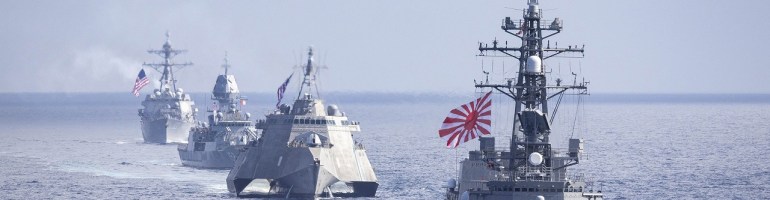

How to preserve peace and deter war? “Japanese think tank’s war game over Taiwan exposes weaknesses. JFSS calls for closer coordination between Taipei, Washington, and Tokyo to fight future China threat,” Taiwan News. Geostrategery, Taiwan Republic 台灣国, and world history classrooms. A quasi-official Japanese think tank holding a wargame with quasi-official Taiwanese officials is a breakthrough. Professor Lai’s calls for clarity from Japan and the US, and for direct communication and coordination between Taiwan Republic, Japan, and the US are important for the preservation of peace in the Indo-Pacific.
There is an endless argument over how to preserve peace and deter war. Advocates for strategic ambiguity, for example, assert that with ambiguity, America has been able to “manage” the military balance in the Indo-Pacific, while “double deterring” both sides of the Taiwan Strait from “escalating tensions” and causing war. This view ignores the fact that one cannot find major political figures in democratic Taiwan advocating for war or radical, instability-causing policies – unless one defines democratic sovereignty as provocative. The war talks are coming from the Chinese communists and their allies inside Taiwan and the Free World. This begs a question: if the Chinese communists had the military capability in the 1990s to invade and annex Taiwan, with none of the conciliatory, engagement-oriented, strategically ambiguous policies unchanged on the American side, are we certain that the Chinese communists would not have started a war back then? When the US and NATO were still attempting to reset their relationships with Putin, did his efforts to undermine Ukrainian sovereignty subside? Did it modify his attempt to destroy Western democracies from within?
This leads to a strategic question: what do the Chinese communists want? There is a divide on this question regarding both the Chinese communists and Putin’s Russia. Some treat dictator Xi’s communist China and dictator Putin’s Russia as merely another great power, another normal nation in the dysfunctional family of nations. Based on that assumption, dictator Putin invaded Ukraine because NATO posed a threat, and Putin merely wanted to improve his nation’s security, and Xi has become increasingly belligerent because the Taiwanese dare to hold free and fair democratic presidential elections and chart their own ways. If only Ukraine and Taiwan would negotiate with Moscow and Beijing they argue – but to negotiate what? Well, negotiate away their own democratic sovereignty, and then there will be peace in our time.
What if the main source of friction is a disagreement over what the world order ought to be? An American-led postwar world order versus a return to a fragmented, regional powers-dominated sphere of influence order – a Social Darwinian, might makes right, a multipolar world full of regional imperialisms where the larger powers always have the right to militarily subdue their unfortunate smaller neighbors?
For the current phase of the Indo-Pacific crisis instigated by the Chinese communists, clarity from the US and Japan would go a long way to deter Chinese imperialism and militarism. Had dictator Putin known that the US and NATO would not allow his dictatorship to survive if he invaded Ukraine he would have made a different calculation. What we do know is that strategic ambiguity – Ukraine edition, coupled with attempts at dialogue, and even threats of economic sanctions, failed to deter Putin.
Ambiguity from the Free World aside, Putin also received erroneous information from his national security leaders, and the anti-democracy and anti-Ukraine forces inside Ukraine. This is where Professor Lai’s advice to Japan and the US is most important. Much of what dictator Xi and the Chinese communists are hearing about Taiwan is coming from the anti-Taiwan and anti-democratic China KMT and its allies – that the Taiwanese military is brittle, that Taiwanese soldiers will surrender at the first sign of trouble, that DPP politicians will flee, that America is a paper tiger and will not put up a fight. Sound familiar? How did dictator Putin come to believe that an elite paratrooper unit landing at the Kyiv Airport would lead to a quick, painless victory to subdue democratic Ukraine? In modern Chinese history, the China KMT is always corrupt and inept, whereas the Chinese communists are evil but competent – a competency that is borne of cold-blooded rationality. This is why clarity in words (a Chinese-instigated war will end the communist dictatorship) and actions (official and public dialogue between national security leaders of Taiwan and the Free World and regular rotations of American and allied forces into Taiwan) from the US, Japan, and the Free World regarding the price Beijing will pay if they choose a war of annexation against Taiwan are the key to preserve peace. 14.7.2024
© Taiwan in World History 台灣與世界歷史. This site grants open access for educational and not-for-profit use. Maps and illustrations are borrowed under educational and not-for-profit fair use. If you are the rights holder and prefer not to have your work shared, please email TaiwanWorldHistory (at) Gmail (dot) com and the content will be removed.
 Taiwan in World History (台灣與世界歷史)