Category Archives: Taiwan Republic

Strategic clarity required for ‘Hellscape/Porcupine’ to work: “‘Hellscape’ Swarms Could Be a Cost-Effective Taiwan Defense, Says Report,” USNI News. Taiwan Republic 台灣国, geostrategery, and world history classrooms.

Strategic clarity required for ‘Hellscape/Porcupine’ to work: “‘Hellscape’ Swarms Could Be a Cost-Effective Taiwan Defense, Says Report,” USNI News. Taiwan Republic 台灣国, geostrategery, and world history classrooms. This is an excellent report from CNAS with an informative discussion session available on The YouTubes (see link below). Because of the lost eight years under anti-democracy and anti-Taiwan Ma, and the leadership deficiencies within the reactionary China KMT-led Taiwan national security establishment, Taiwan Republic is decades behind in its military unmanned vehicle developments. Therefore, this is a timely push for Taiwan’s security against the China Threat.

For CNAS’s thoughtful suggestions and the broader Indo-Pacific Command’s “Hellscape” unmanned vehicle vision to be adopted by Taiwan, an honest and accurate memory of America’s decades-long erratic and contradictory policies towards Taiwan, coupled with a commitment to strategic clarity are necessary.

On accurate and honest historical memory – too many American policymakers have either amnesia or self-serving rationalizations (imperialist hubris), on the decades of restrictive American policies towards arms Taiwan may import, coupled with ambivalence towards Taiwan’s national survival in the case of a Chinese invasion. Ideally, Taiwan ought to focus on homeland defense and making the Taiwan Strait a “hellscape” for the Chinese invasion force – though this focus would only make sense, and would be easier for democratically elected civilian leaders in Taiwan to push these changes through the national security establishment, if Taiwan has concrete assurances from the US and democratic allies that this close range, homeland defense “hellscape” is part of a broader tactical and strategic plan – with the US, Japan, and other democratic allies committed to neutralizing medium to long range Chinese targets.

Strategic clarity from the US addresses another problem – over the last four decades, erratic and self-contradictory policies from the US regarding Taiwan’s national security have wasted time and money for Taiwanese taxpayers – by forcing Taiwan into purchasing substandard weapons (Olivard Hazard Perry frigates instead of AEGIS destroyers is a good example; Sparrow air-to-air missiles instead of AMRAAMs is another ….) from the US in the name of “managing” parity across the strait, or by the US forcing Taiwan to invest in manufacturing their own weapons that the US refuses to sell. In many cases, such as the Taiwanese jet fighter IDFs – Taiwan does not have the technological know-how, nor the economies of scale, to make such an investment rational – for all of the American think tankers complaining in 2024 about Taiwan not spending enough on defense, and/or purchasing too many big-ticket weapons, what would have happened had the US sold F-16s to Taiwan in the early 1980s, and Taiwan had been able to divert half of the cost of running around in circles developing its own inferior IDFs into unmanned aerial vehicles? But imperialist hubris means never having to say you are sorry, or even that you remember, right?

There are still American imperialist academics and policymakers who stubbornly hold onto strategic ambiguity, arguing that US policy is based on “double deterrence” – i.e., deterring a Chinese communist invasion while also deterring Taiwanese formal independence. One should challenge anyone who, in 2024, still repeating this antiquated formulation to name a mainstream pro-Taiwan and pro-democracy leader in Taiwan Republic over the last two decades who is either advocating formal independence, or pro-war? To the best of my knowledge, the only idiots left on planet Earth who are seriously advocating immediate formal independence and/or war are the Chinese, their anti-democracy allies inside Taiwan, and American academics and think tankers who still believe the US “giving” democratic Taiwan to the Chinese would lead to peace in our time.

Strategic clarity and commitment from the US and allies allow Taiwan’s democratically elected civilian leaders to plan rationally on how best to reallocate limited national security resources – for example, deciding which unmanned vehicles are worthwhile to domestically develop; and which are best license-produced in cooperation with US manufacturers; and which are best imported from abroad. From jet fighters to missiles, from naval vessels to armored vehicles, Taiwan’s military inventory is a museum of the decades of misguided and self-defeating American policy towards communist China and the Indo-Pacific. This is the opportunity to fundamentally discard Strategic Ambiguity in favor of clarity in the defense of global democracies, hence, core American national interest. 4.7.2024

“Swarms over the Strait: Drone Warfare in a Future Fight to Defend Taiwan” https://www.youtube.com/watch?v=OLl5xgPl7VA

© Taiwan in World History 台灣與世界歷史. This site grants open access for educational and not-for-profit use. Maps and illustrations are borrowed under educational and not-for-profit fair use. If you are the rights holder and prefer not to have your work shared, please email TaiwanWorldHistory (at) Gmail (dot) com and the content will be removed.

Leave a comment

Filed under geostrategery, Taiwan Republic, world history

President Tsai Ing-wen and this emerging Taiwanese national identity, part three, the dead-end of the “blood and soil” Chinese nationalism. Taiwan Republic 台灣国, national identity, and world history classrooms.

President Tsai Ing-wen and this emerging Taiwanese national identity, part three, the dead-end of the “blood and soil” Chinese nationalism. Taiwan Republic 台灣国, national identity, and world history classrooms. This week Taiwan’s army presented prototypes of an indigenous 105mm wheeled armor vehicle. Taiwanese netizens rapidly made a size comparison of the proposed wheeled 105 mm vehicle with the M-1A2T MBTs coming to Taiwan. Further improvements will be made, though it has been interesting to follow the discussion-debate on its viability in the Taiwanese civil space.

During the democratic era, Taiwan Republic has had four presidents — Lee, Chen, Tsai, and Lai. Decades apart, Chen and Lai share the fate of facing a pro-China pro-autocracy majority in the parliament, but for foreign and domestic reasons Lai is in a far stronger position. I have been writing about different elements of why this is the case, as a way of analyzing the formation of modern Taiwanese national identity. An interesting indicator is in the realm of national security. For historical-political reasons, during Chen’s eight years in the 2000s the national security area, public and private, was monopolized by the so-called “mainlanders,” and a particular subset – veterans of China KMT dictatorship’s military, who spent decades forcing the subjugated Taiwanese to be anticommunists, until the democracy era, when they decided Taiwan independence is far worse than Chinese communism. What’s left of that group is the embodiment of a “blood and soil” type of reductivist, violent, anti-democratic Chinese nationalism.

It is not so much that with time these Chinese Taipei occupiers mellowed — in fact, many have become more radicalized — it is that their numbers have noticeably been reduced because Tsai’s eight years opened the door to those associated with the population that fled to Taiwan between 1945-1949 who maintain a sentimental attachment to “RoC” but also are pro-democracy to join with the pro-democracy and pro-not surrendering to the Chinese communists Taiwanese mainstream. Many of the online and YouTube civilian Taiwan military analysts I follow may well have voted for the reactionary and anti-democracy Ma twice, and may still vote for China KMT candidates on the legislative and local levels. But on presidential-national identity-democratic sovereignty issues, they have become a part of Tsai’s emerging domestic consensus on “RoC” Taiwan and its democratic sovereignty. Taiwan, as is the case with the US and Europe, is a good case study of why blood and soil type nationalisms may achieve short-term political gains but result in long-term national dead-ends — while Tsai’s liberal-democratic nationalism – the idea that being Taiwanese citizens is defined by adherence to a set of democratic values and principles and not based on blood and lineage — is such an important principle for Lai and allies domestic and foreign to promote and to protect. 27.6.2024

[Illustration from 新‧二七部隊 New 27 Brigade at https://www.facebook.com/photo?fbid=122154187856155786&set=a.122105799836155786]

[Analysis of the armored vehicle at Tommy Chi諸葛風雲的異想世界https://www.youtube.com/watch?v=Tlp34pK3png]

© Taiwan in World History 台灣與世界歷史. This site grants open access for educational and not-for-profit use. Maps and illustrations are borrowed under educational and not-for-profit fair use. If you are the rights holder and prefer not to have your work shared, please email TaiwanWorldHistory (at) Gmail (dot) com and the content will be removed.

Leave a comment

Filed under geostrategery, Taiwan Republic, world history

“Han Kuang drills to switch focus. ADAPTING: The annual live-fire exercises would include night-time drills and test how units would perform after losing contact with central command,” Taipei Times. Geostrategery and Taiwan Republic 台灣国 classrooms.

“Han Kuang drills to switch focus. ADAPTING: The annual live-fire exercises would include night-time drills and test how units would perform after losing contact with central command,” Taipei Times. Geostrategery and Taiwan Republic 台灣国 classrooms. With any complicated, difficult reforms, one has to start somewhere. Given the many decades of failed reforms with the Chinese Taipei national security establishment, one can understand the immediate reactions of pessimism – however, there is a difference between cautious pessimism and cynicism-nihilism. President Lai’s civilian Minister of National Defense, hopefully with powerful assistance from the Taiwanese national security reformers and American and Japanese advisers, is taking important steps. His will not be an easy task. The Chinese Taipei national security establishment cannot win a war, but they are experts at sabotaging democratic reforms.

The historical context to remember. Just as Taiwanese democracy has had to temporarily adapt to unwieldy, poorly designed, anti-democratic China KMT institutions, Taiwan’s Chinese Taipei national security establishment is an even lesser evolved legacy from the Chiang Kai-shek crime family and dictatorship. A military designed by a paranoid, incompetent dictator who saw no difference between his “family,” his “political party,” and his “dictatorship” – the holy trinity of China KMT. The top line’s key point is – that it was not a military designed to fight independently and to protect the nation or its democratic sovereignty – this was a national security apparatus created with only one task – to protect the dictator and his dictatorship. 

One might argue well fine but both Chiang dictators are long dead, Taiwan has been a democracy since 1996 – this is why I have long noted that for a variety of historical and political reasons, the Taiwan national security establishment has been the least impacted by Taiwan’s modernization and democratization. The danger inherent in this gap can be seen with high-level Chinese Taipei generals and intelligence officers not so much with national identity confusions, but are expressly loyal to the Chinese communists. The additional danger is an important lesson from Ukraine – a military that is insulated from how its democratic nation works will not be able to fight effectively – Taiwan’s obsolete, authoritarian military establishment and its foreign, colonialist mentality prevent it from fully understanding Taiwanese dynamism – where its IT experts are, whether its globally significant online gaming community may contribute to its modern warfare capacity.

Even something as simple as propaganda – go randomly select a Chinese Taipei Ministry of National Defense propaganda film, note the soundtrack, and ask yourself – is this the kind of music popular in Taiwan, particularly for its recruitment age young citizens? Does it have the kind of online, wry humor Taiwanese citizens enjoy?

While the Chinese Taipei national security establishment is designed to protect the dictator and not so much to fight wars, they are experts at sabotaging reforms. I expect the usual suspects with their collaborators in the Chinese Taipei-dominated military press to find ways to defeat these necessary improvements to the Taiwanese military. The question for the ruling DPP, civil society, and Taiwan’s democratic allies will be, how serious are we this time, and if we are serious, then are we prepared for the information warfare against military reforms that have already started?

© Taiwan in World History 台灣與世界歷史. This site grants open access for educational and not-for-profit use. Maps and illustrations are borrowed under educational and not-for-profit fair use. If you are the rights holder and prefer not to have your work shared, please email TaiwanWorldHistory (at) Gmail (dot) com and the content will be removed.

Leave a comment

Filed under geostrategery, Taiwan Republic

“US officials say UN Resolution 2758 twisted: sources. UNDER THE RADAR: Two US deputy assistant state secretaries visited Taiwan and met with foreign diplomats to discuss how to boost the nation’s international participation,” Taipei Times. Taiwan Republic 台灣国, geostrategery, and world history classrooms.

“US officials say UN Resolution 2758 twisted: sources. UNDER THE RADAR: Two US deputy assistant state secretaries visited Taiwan and met with foreign diplomats to discuss how to boost the nation’s international participation,” Taipei Times. Taiwan Republic 台灣国, geostrategery, and world history classrooms. Even though arguing over the textual meaning of UN resolutions is something that my students roll their eyes over, this is as important as weapons and troops because it goes to the heart of the American and Free world’s position on Taiwan Republic’s democratic sovereignty. The combat jets and naval vessels are necessary to carry out geostrategery policies – but clarity on the international, sovereign boundaries between the People’s Republic of China and the “Republic of China” Taiwan is an important step in fixing the decades-long American mistake made in the name of strategic ambiguity. Not the least in clarifying whether or not the Free World has a legitimate reason to come to democratic Taiwan’s aid if the Chinese communists choose to invade – is it a Chinese civil war (no!), or is it, like Russia invading Ukraine, one nation invading another (yes!!)? This is why the China KMT has vehemently opposed one citizen one vote direction presidential elections in Taiwan.

Just as Taiwanese presidents Dr. Tsai and Dr. Lai must make domestic and diplomatic concessions – weighing relative tranquility with needed reforms – and hence the current mainstream position inside Taiwan regarding the meaning of democratic sovereignty is that the PRC and the RoCTaiwan are not subservient to one another but Taiwan as of now will hold onto the tragic-comedic formal name “RoC” – global powers must balance between changing facts and policy inertia. Although in the realm of recognizing China as a threat to global democracies, shoring up Taiwan’s de facto independence, and redefining the “status quo” as near-permanent, things have been moving at light speed.

My educated guess is this: with the latest trip to China made by the reactionary, fascist, anti-democratic former China KMT Chair Ma, and with the “mainstream” China KMT leadership loudly denying Taiwan’s democratic sovereignty, the only remaining usefulness of the China KMT to the Chinese communists is for the China KMT to recognize that the People’s Republic of China as the only legitimate representative of One China, and to concede that Taiwan must be annexed and ruled underneath this PRC-One China. If DC, Tokyo, London, and other liberal democratic capitals see this trend clearly, then they know that once the China KMT crosses that line into official surrender, the Free World must fully recognize Taiwan’s democratic sovereignty as a response. 23.6.2024

© Taiwan in World History 台灣與世界歷史. This site grants open access for educational and not-for-profit use. Maps and illustrations are borrowed under educational and not-for-profit fair use. If you are the rights holder and prefer not to have your work shared, please email TaiwanWorldHistory (at) Gmail (dot) com and the content will be removed.
Leave a comment

Filed under geoeconomics, geostrategery, Taiwan Republic, world history

“US needs to invest in cheaper long-range drones for Taiwan scenario, report says. “I don’t know if it’s going to be a fair fight,” Breaking Defense. Taiwan Republic 台灣国, geostrategery, and world history classrooms.

“US needs to invest in cheaper long-range drones for Taiwan scenario, report says. “I don’t know if it’s going to be a fair fight,” said Stacie Pettyjohn, director of CNAS’s defense program and one of the authors of the report. “There are a lot of things that are stacked up against the United States when it’s playing an away game,” Breaking Defense. Taiwan Republic 台灣国, geostrategery, and world history classrooms. This is a fair report with useful suggestions. It is good to see that years ago President Tsai, and now President Lai, are taking these ideas seriously – though as is often the case, the resistance is coming from the Chinese Taipei, ossified, reactionary generals. The most worrisome reality is not about the “home game/away game” idea – war is not a ‘game’, is it? It is that the analysts focused on the two weakest parts of the Pentagon and postwar US public policy making – this obsession with thinking that one can use technology and printing money to avoid sacrifices needed to achieve important national objectives. The American failure in the recent pandemic is a textbook case study. All the weapon’s programs where there was a supposedly a hi-lo mix – “cheaper” F-16s at a higher numerical rate, “cheaper” Constellation frigates …. Inevitably the cost of the “cheaper” units climbs as more and more functionality and technology gets added. Wasn’t the F-35s supposed to be a more affordable jet fighter? This is why even though a nation Taiwan’s size ought to focus more on license producing and importing American weapons, the per unit price is prohibitively high – could Israel afford the world-class military with top-line US weapons without US financing?

Weapons alone – “Hellscape” and “Porcupine” and so on, will not deter and defeat Chinese communist imperialism and military adventurism. As is the case with Putin’s Russian imperialism – the authoritarian’s assumption is that the US is unfocused, short-attention spanned, without courage and conviction, not a serious empire. Putin’s disastrous bet on Ukraine is that the US and NATO would issue emotive diplomatic statements, pass symbolic feel-good sanctions, hand wring, but not really act – and to be fair, the US and NATO had been erratic and indecisive regarding Russian imperialism and military aggressions in the decades ahead. Down to the embarrassing malfunctioning “reset” button. Seen from Beijing’s perspective, US policies regarding Chinese imperialism and military belligerence have also been erratic. How does one convince the communist dictators of China that the US and its democratic allies are serious and committed this time while remaining measured? Sooner or later a small but visible contingent of US and allied soldiers must be rotated in and out of Taiwan to signal to communist China that this is a war they do not want to start. Without a physical presence, one can see why a perfectly “rational” dictator Xi may talk himself into guessing that America is a paper tiger. 22.6.2024

© Taiwan in World History 台灣與世界歷史. This site grants open access for educational and not-for-profit use. Maps and illustrations are borrowed under educational and not-for-profit fair use. If you are the rights holder and prefer not to have your work shared, please email TaiwanWorldHistory (at) Gmail (dot) com and the content will be removed.

Leave a comment

Filed under geostrategery, Taiwan Republic, world history

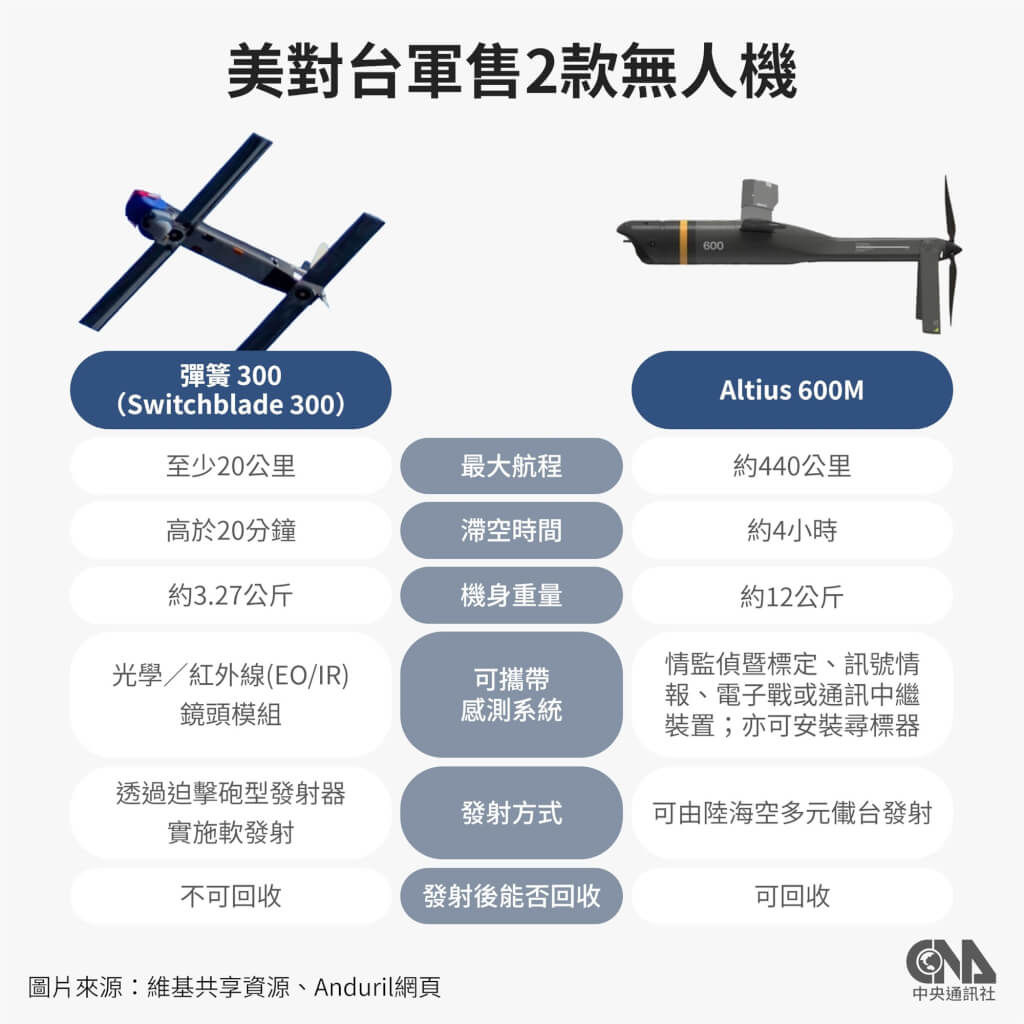
“Sale Of Over 1,000 Kamikaze Drones To Taiwan Points To Grand “Hellscape” Counter-China Plans. Masses of loitering munitions could engage approaching Chinese landing craft, as well as targets ashore, and overwhelm vessels in the Taiwan Strait,” The War Zone. Taiwan Republic 台灣国, geostrategery, and world history classrooms.

“Sale Of Over 1,000 Kamikaze Drones To Taiwan Points To Grand “Hellscape” Counter-China Plans. Masses of loitering munitions could engage approaching Chinese landing craft, as well as targets ashore, and overwhelm vessels in the Taiwan Strait,” The War Zone. Taiwan Republic 台灣国, geostrategery, and world history classrooms. The only way to deter-prevent-defeat a war against a dictatorship like communist China is to speak clearly and to prepare for an invasion decisively. “Hellscape” and “kamikaze” are provocative words. The most encouraging signs are that national security leaders in Taipei and DC, Tokyo, and London are finally taking the existential threat posed by Chinese imperialism seriously – and that the preparations are now into the less provocative, but “real” levels – training, munitions, supply chains, spare parts, hardening bases, dispersing command and control nodes, and so on. Not as evocative and sexy as “hellscape,” but these preparations will make the difference between victory and defeat.

These American drones are but one small point in a thousand policy changes within the US-led Indo-Pacific security preparation to deter and defeat the China Threat. On the Taiwan Republic side, encouraging signs that the new president and his civilian Minister of National Defense are leading the charge to democratize and modernize the national security establishment – a China KMT imposed establishment with a national identity crisis, to a mentality that is stuck in the era of the 1930s. For a high-technology superpower with millions of IT specialists and online gamers, the bottleneck preventing Taiwan from becoming an unmanned vehicle superpower has always been within the Chinese Taipei-China KMT national security establishment – one is hopeful that the new leadership in Taiwan, with US and democratic allies’ assistance, can change this. These drones should also be another opportunity for the US and democratic allies to routinize training and collaboration between their armed forces and Taiwan’s military. President Tsai wisely started a Taiwanese Unmanned Vehicle “national team” of civilian manufacturers – this is also an opportunity for the US and its democratic allies to include Taiwan in the global democratic UAV supply chain.

The most reassuring part of this report is that the US Indo-Pacific command apparently realizes the mistakes the US and NATO made in Ukraine. The US and NATO policy in Ukraine has succeeded on the “porcupine” side – short-range Javelins and 150mm howitzers and HIMARS along with Ukrainian bravery and ingenuity allowed democratic Ukraine to prevent the much larger authoritarian Russia from annexing Ukraine. These shorter-range drones Taiwan is importing from the US, along with Javelins and TOWs and HIMARS and Stingers, the defensive sides of “Hellscape,” are roughly what’s occurred in Ukraine. However, lacking long-range counter-strike options, for over two years Russia has been allowed to pummel Ukraine with little to fear for its own military and civilian resources. This is not about “fairness” – by allowing this, the Russians have had no real incentive to cease their aggression. In fact, they have had time to source resupplies from Iran, communist China, and North Korea, knowing that the Russian homeland is largely untouched by the war they chose to start. Obviously, Beijing cannot be allowed to think that if they choose to start a war to invade Taiwan they would be afforded a similar arrangement – Chinese communist targets, military and civilian, must be disrupted immediately to interfere with the ability of the Chinese invaders to succeed. 20.6.2024

[Photo from Taipei Times: https://www.taipeitimes.com/News/taiwan/archives/2021/12/25/2003770170

]

© Taiwan in World History 台灣與世界歷史. This site grants open access for educational and not-for-profit use. Maps and illustrations are borrowed under educational and not-for-profit fair use. If you are the rights holder and prefer not to have your work shared, please email TaiwanWorldHistory (at) Gmail (dot) com and the content will be removed.

Leave a comment

Filed under geostrategery, Taiwan Republic, world history

President Tsai Ing-wen and this emerging Taiwanese national identity, part two, Returning the China KMT to China. Taiwan Republic 台灣国, national identity, and world history classrooms.

President Tsai Ing-wen and this emerging Taiwanese national identity, part two, Returning the China KMT to China. Taiwan Republic 台灣国, national identity, and world history classrooms. For the first time in eight years, Taiwan’s legislature has a pro-communist-China majority, and with street protests and headlines, it feels as if Taiwanese democracy has descended into chaos. However, with historical context, particularly comparing President Lai’s first term with President Chen’s perilous eight years, this emerging Taiwanese national identity during President Tsai’s exceptional eight years has created an entirely different domestic and global reality.

President Tsai’s DPP has co-opted symbols and iconographies of “RoC” as “RoC Taiwan” – pro-democracy, anticommunist, Taiwanese democratic sovereignty – for a remarkable example, see President Lai’s recent speech at the ‘RoC’ Army Academy. This means the DPP now occupies a mainstream position within Taiwan’s democratic polity, while at the same time, the China KMT’s former president Ma has repeatedly rejected Taiwan’s democratic sovereignty, and its current vice chair visited communist China asserting that Taiwanese are also “Chinese 中国人”。China KMT’s radicalization has, given Ma’s recent trip to communist China, meant that the only major concession left of any worth that the China KMT has to give to Beijing is to acknowledge that the “one China” they support is the People’s Republic of China, and that Taiwan and Taiwanese should be subjects – dictatorships have subjects and no citizens — of this communist China. If you think of the Taiwanese political spectrum as running from China/Chinese to Taiwan/Taiwanese, and from democracy to authoritarianism – President Lee’s dream of a moderate, indigenized Taiwan KMT was the last chance that this authoritarian foreign party had to remain competitive in national elections in Taiwan – whereas President Tsai has pulled DPP into a larger, more moderate domestic coalition – acceptable to US and the Free World.

Another way to think about the China KMT’s radicalization, and now the fledgling China People’s Party, and their quandary – with possible reliance on foreign financial support, an absolute minority of hard-core anti-democracy and pro-China supporters (think of the same dilemma faced by American GOP candidates, with a MAGA dominated party primary, and a moderate-centrist voting citizenry). Leave aside one’s own value judgment, let’s ponder electoral politics. If you are the China KMT, and you have been in the political wilderness for eight years, and for the first time since Taiwan became a democratic nation, a two-term incumbent DPP president has successfully extended DPP’s presidential term to the sitting VP, and you barely won a legislative majority – would the reasonable electoral strategy to expand your future electoral coalition _in Taiwan_ in both the legislative and executive branches be to promote highly polarizing, anti-democratic, and pro-communist China legislations? The DPP has many domestic political weaknesses – dissatisfied younger voters, income inequality, housing crisis, educational stagnation …. Yet the China KMT and People’s Party chose highly polarizing, ideologically pro-communist China legislation to begin. Doesn’t make any sense does it.

The only way China KMT’s legislative agenda makes any sense is to understand how Taiwan’s emerging national identity has evolved under President Tsai, and how a moderate status quo DPP has become a political dilemma faced by a radicalizing anti-democratic China KMT. The China KMT’s latest presidential candidate, New Taipei mayor Hou, himself a native Taiwanese, spent years painstakingly avoiding polarizing pro-China issues, and kept the China KMT at arm’s length – yet right after he was nominated by the China KMT, he too could not overcome the pressure by his radicalized party’s leadership to nominate a pro-China VP candidate, and to accept electorally disastrous policies (granting electoral right to Chinese communist subjects; opening Taiwanese job markets to Chinese communist students). A sensible candidate without this baggage known as the China KMT might have focused on center-right issues – housing, pollution, education, income equality, or after eight years of DPP executive and legislative majority, a candidate with a party not beholden to the Chinese communists might have wisely simply focused, as Obama did, on “change.”

While President Tsai did not push the China KMT towards radicalization – that pro-China anti-democracy coup started when Ma and Lien pushed Lee out of the China KMT, and came as a result of financial dependency, ideology, and primarily due to an authoritarian minority used to colonialist privileges resenting democratization removing those bounties – Tsai pulling the DPP into the moderate status quo position and coopting ‘RoC’ institutions and iconographies – the DPP took over the ideological, national identity vacuum abandoned by the China KMT. Therefore, President Lai’s position is far more stable than President Chen because of this shifting domestic and global landscape. The unique challenge he faces is that as the China KMT becomes radically anti-democracy and pro-Chinese annexation, Taiwan’s democracy will face sharper challenges because Taiwan’s major opposition parties are essentially insurrectionists. With time one assumes (hopes?) an opposition party that affirms Taiwan’s democratic sovereignty will emerge – but for the time being, this will be a challenging moment, particularly given China’s desperation and direct interference into Taiwanese democracy. 18.6.2024

© Taiwan in World History 台灣與世界歷史. This site grants open access for educational and not-for-profit use. Maps and illustrations are borrowed under educational and not-for-profit fair use. If you are the rights holder and prefer not to have your work shared, please email TaiwanWorldHistory (at) Gmail (dot) com and the content will be removed.

Leave a comment

Filed under geostrategery, Taiwan Republic, world history

“US to deliver TOW-2B missiles this year. MORE FIREPOWER: The TOW-2B missiles can be used to attack tanks and bunkers, and destroy landing ships, which would greatly bolster the nation’s defense capabilities,” Taipei Times. Geostrategery, Taiwan Republic 台灣国, and world history classrooms.

“US to deliver TOW-2B missiles this year. MORE FIREPOWER: The TOW-2B missiles can be used to attack tanks and bunkers, and destroy landing ships, which would greatly bolster the nation’s defense capabilities,” Taipei Times. Geostrategery, Taiwan Republic 台灣国, and world history classrooms. The TOW-2B anti-armor missiles are good examples of where the US and the Free World should begin to test the best ways to bring Taiwan Republic into the arms manufacturing supply chains and begin to bring larger Taiwanese military units to the US and allies, and rotate American and Japanese units into Taiwan, for training and coordination.

As luck would have it – President Tsai spent eight years repairing the severe damage done to Taiwan’s national security caused by the China KMT’s Ma and his defeatist surrender monkeys. So, there are many new weapon systems purchased by President Tsai for the US and allies to use as models for training, joint maneuvers, information sharing, and supply-chain/maintenance coordination. These new systems range from F-16Vs to M-1A2T, to shore-based Harpoons, to HIMARS, Javelins, Stingers, AMRAAMs, and Sidewinders.

The most important part of this report, and the most critical task of this new unusual civilian Minister of National Defense of Taiwan, is dealing with the Chinese Taipei entrenched national security establishment. One of the problems are national identity crisis within the military’s leadership. Other problems are long unresolved inter-services rivalries. The CSIST – Taiwan’s military-run center for domestic weapon research and manufacturing — was established under dictator Chiang Kai-shek as a military-centered, secretive weapons development center. Like the national security establishment in general, CSIST has not yet adjusted to the modern, democratic age. Taiwanese democratic polity has not debated and discussed what role CSIST should play, what its strengths are, and where it might need to curtail its portfolio. This problem is a subset of a broader issue – among Taiwan’s many problematic transitions from the China KMT dictatorship to a modern sovereign democracy, the national security establishment has been the most insulated/isolated from that transition.

Another problem with long-needed reforms of the CSIST and strategic resource reallocation for Taiwan-designed/made weapons has been the history of the erratic behavior of the United States towards the region and Taiwan. Western imperialist think tankers in DC and policymakers may circle the wagon and claim otherwise – the reason some Chinese communist and China KMT conspiracy theories about America abandoning Taiwan have plausibility is because there were significant moments in recent history when the US sacrificed Taiwanese security interests to placate the Chinese communists. Prominent examples include unreasonable restrictions on updating Taiwan’s combat jets, to preventing Taiwan from acquiring submarines, to refusing to supply Taiwan with antiship missiles, to interfering with Taiwan acquiring cruise missiles, and so on. And so, in this historical context, even civilian Taiwanese leaders most friendly to the United States cannot ignore this history and abandon homegrown weapon systems altogether.

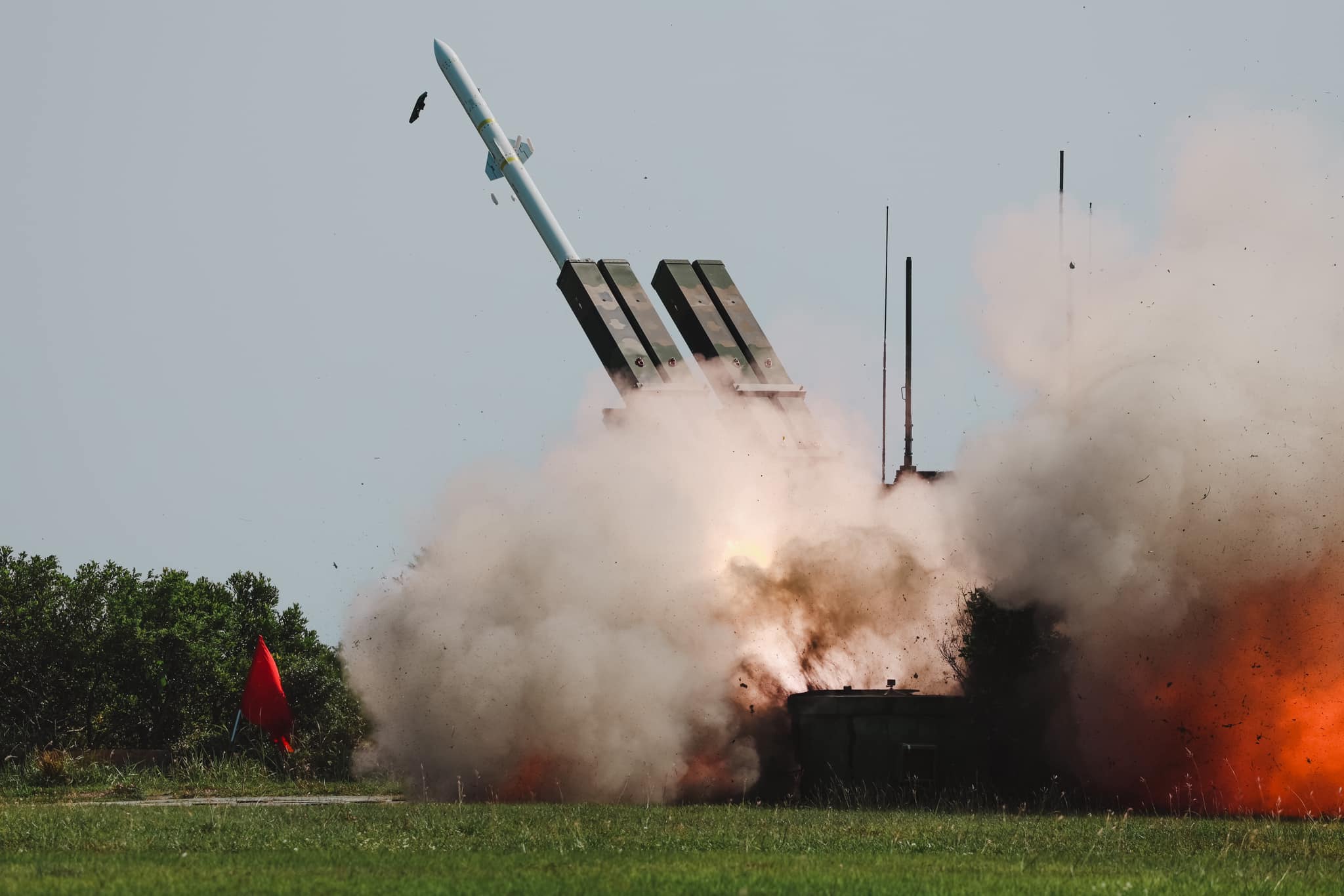
The most sensible first step for the United States is to have greater strategic clarity towards the region and Taiwan, while testing new collaboration with specific weapon systems. For example: Taiwan has developed comprehensive surface-to-air and surface-to-surface missiles – TK 1, 2, and 3 for SAMs, and HF 2, 3, and 3ERs – are there ways for the US and Taiwan to collaborate on how these Taiwan-made systems can be integrated into US Patriots and Harpoons? This is where something like a TOW2B or Javelins – not super complex – license-produced in Taiwan – may also be a good, concrete first step – to signal a different American commitment, to test out the strengths and weaknesses of Taiwanese arms manufacturing, and to find weak points in Taiwan’s security system (leaks of classified information to China) before testing out collaborations in higher level weapons. 18.6.2024

[photo borrowed from Taipei Times: Photo: Lo Pei-de, Taipei Times]

© Taiwan in World History 台灣與世界歷史. This site grants open access for educational and not-for-profit use. Maps and illustrations are borrowed under educational and not-for-profit fair use. If you are the rights holder and prefer not to have your work shared, please email TaiwanWorldHistory (at) Gmail (dot) com and the content will be removed.

Leave a comment

Filed under geostrategery, Taiwan Republic, world history

“US bill calls for arms stockpile to aid Taiwan. BUILDING TIES: A US House version of an NDAA bill would require that the Pentagon report on efforts to bolster defense industry cooperation with Taiwan,” Taipei Times. Taiwan Republic 台灣国, geostrategery, and world history classrooms.

“US bill calls for arms stockpile to aid Taiwan. BUILDING TIES: A US House version of an NDAA bill would require that the Pentagon report on efforts to bolster defense industry cooperation with Taiwan,” Taipei Times. Taiwan Republic 台灣国, geostrategery, and world history classrooms. It is interesting to see continued bipartisan legislative leadership on the emerging American strategy in the Indo-Pacific. The joint naval drill led by Japan with vessels from Canada, the Philippines, and the US in the South Sea is another news over the weekend to note. And the admiral in charge of the Indo-Pacific command visiting Indonesia is super important – Indonesia, like India, is not likely to become a formal ally – but when China starts a war, it is critical that neither Indonesia nor India stay fully neutral.

These annual legislative pushes from Congress for the executive branch to do more and to be more decisive are a reminder that America has yet to have a full, national, alliance-wide strategic reappraisal of the threat to its national security posed by communist China. This is where episodic banning of companies – TikTok, DJI drones, Huawei, etc. – misses the point. China has waged a coherent, strategically clear war against liberal democracies since 1949 – while liberal democracies have been in a dreamscape, well-meaning, naïve, self-serving. Engagement as the US and the Free World had conducted with China from 1979 to 2024 is what financed the Chinese communists into the leading military threat to liberal democracies. What are the commercial, financial, technological, educational, and other tools of statecraft America may use to decrease the China Threat without going to war? Sure would be nice to have a presidential election cycle where such weighty issues for national survival is debated instead of the usual nonsense, no?

In a similar way, these congressional calls are fine ideas as far as they go – but they lack an overarching coherence – perhaps because the executive branch is still stuck in over cautiousness, bureaucratic inertia, the hubris of thinking a continental empire like the Chinese communists can be “managed.” To stockpile munitions in and around Taiwan Republic in case of a Chinese invasion would require a national, and alliance-wide, strategic vision. From strategy to doctrine, from tactics to coordination. If the Americans and allies are to store munitions inside Taiwan, how should the Taiwanese national military go about its own national military planning? Likewise, the plan is to bring Taiwan into the American national security supply chains. Wouldn’t it make sense to quickly pick a few obvious, less challenging items – Javelins, Stingers, Sidewinders – to license produce in Taiwan with American supervision, to test the collaboration process, and for the US to aid in Taiwan’s ability to prevent classified information from being stolen by the Chinese? Here too the American national security supply chain requires a commitment and strategic clarity for Taiwan to either curtail or modify its own domestic weapons program.

The most obvious next concrete steps to normalize American relations with Taiwan as a sovereign nation is to license produce those lower-end weapons, and to use American weapons Taiwan has already purchased — like the new M-1A2T main battle tanks, HIMARS, and land-based Harpoon anti-ship missiles — to rotate American sailors, soldiers, and marines into Taiwan to “train and coordinate,” unit to unit – eventually, ideally, these rotations would involve all branches on all levels – from command to small outposts, from the three branches to logistics and intelligence and military academies and so on. Here again, a national strategy and clarity from the American side is required. 17.6.2024

© Taiwan in World History 台灣與世界歷史. This site grants open access for educational and not-for-profit use. Maps and illustrations are borrowed under educational and not-for-profit fair use. If you are the rights holder and prefer not to have your work shared, please email TaiwanWorldHistory (at) Gmail (dot) com and the content will be removed.

Leave a comment

Filed under geoeconomics, geostrategery, Taiwan Republic, world history

President Tsai Ing-wen and this emerging Taiwanese national identity, part one. Taiwan Republic 台灣国, national identity, and world history classrooms.

President Tsai Ing-wen and this emerging Taiwanese national identity, part one. Taiwan Republic 台灣国, national identity, and world history classrooms. It will take many decades to fully assess President Tsai Ing-wen’s legacy. Oral history, historical archives, primary documents and not yet available – and this phase of Taiwanese history is particularly significant and dynamic – Western imperialist academics would probably say “fraught” or “nuanced.” So, these reflections are super preliminary. My main thesis: even though by temperament and reputation President Tsai is moderate, almost boring, Taiwanese national identity under her eight years made revolutionary leaps.

Historians tend to credit significant changes to the leaders of that time period – reasonable as a kind of academic shorthand. Of all elements of public life, national identity is the most complex – surely democratically elected president Tsai had an impact on this evolving Taiwanese national identity – but as it is often the case, great leaders also see and hear dynamic changes from the bottom up – and rather than to create those evolutions, they act instead as a channels, creating a path to coherently give words and meaning to these evolving national identities.

To me, the most significant change to this emerging Taiwanese national identity during Tsai’s eight years is that President Tsai, a former China KMT technocrat, miraculously convinced pro-Taiwan DPP supporters to tolerate formal institutions and symbols of the foreign/Chinese-imposed RoC – even up to the bloody reign of the younger Chiang dictator CCK. President Tsai advanced and modified her mentor, Taiwan’s first democratically elected president Lee Teng-hui’s formulation “RoC in Taiwan” into “RoC Taiwan” – starting the periodization at the end of the latest Chinese civil war in 1949, which the China KMT lost before they fled to Taiwan. This is an imperfect, everyone has something to not like compromise – but one which generates a stable, peaceful governing majority among Taiwan’s citizens, and significantly, has the support from the US, Japan, and the Free World. Even though the headlines out of Taipei now are the inevitable counterrevolutions from reactionary, anti-democracy, and anti-Taiwan political parties – if we broaden the historical lens out to centuries of Taiwanese history, the evolution of Taiwanese national identity has always been a two-step forward one or two steps back process.

An important data point to ponder regarding whether the Tsai formulation is transitory or historically significant is to assess the relative positions of new President Lai with former President Chen. Both Chen and Lai had to deal with anti-Taiwan, anti-democracy, and reactionary majorities in the parliament – noise and all notwithstanding, the pro-Taiwan and pro-democracy forces are in far better shape in 2024 than they were in 2000. It was a miracle that President Chen survived the reactionary coup attempts – President Lai has a firmer hold on to the executive branch, pro-democracy majority, and foreign support. And President Tsai’s policies played a significant role in this change – all the boring, non-crowd-pleasing policies she pushed through – pension reforms, improving the standings of the military and civil servants, infrastructure, transforming Taiwan from an international beggar, as the China KMT had formulated, into a positive global contributor, and so on.

The second significant development – and I am still thinking about this – is Tsai’s push for the Taiwanese to ponder, to enact, this emerging Taiwanese national identity apart from the “China-or-Not-China” construct – real independence comes only when the Taiwanese stop habitually comparing themselves first to China, or to China alone. To me, President Tsai’s calls for citizens of Taiwan to think of Taiwan as a part of the world is a significant revolution – to change decades of Chinese colonial, imperialist brainwashing that Taiwan is “only” a cultural periphery of a superior Chinese imperial core. And through an understanding of world history and global studies, to see Taiwan’s historic, and contemporary roles – not as the China KMT had constructed – Taiwan as a beggar, a muddied hinterland without culture or history – but as a democratic, sovereign, dynamic Taiwan nation that is positively contributing to the Free World. In this realm, I think the main dynamism and energy come not from formal, institutional, political quarters – or even formal educational institutions. When President Tsai took President Lee’s comment – “The agony of being Taiwanese” and updated it to become “The pride of being a Taiwanese,” I think she is more reflecting and channeling emerging Taiwanese national consciousness from the ground up than she is creating and leading.

Again, a historical comparison is useful. I think up to the late 1990s Taiwan-as-a-part-of-China was framed in Taiwan by the Chinese colonialist occupational elites as a conscious and subconscious “default” – in different realms of public life, to deviate from that default required strenuous efforts. Whereas in 2024 Taiwan is a nation with democratic sovereignty separate from China and any other nation is the new default. This rapid evolution in modern Taiwanese national identity may well explain why reactionary, anti-Taiwan, and anti-democracy leaders like Ma and other members of the China KMT have sharpened their rhetoric and attacks against Taiwanese democracy. As we have seen with political evolutions in North America and Europe, “white privilege” and “Chinese ‘mainlander’ privilege” share historical similarities. Foreign colonial settlers who have enjoyed decades of unearned, illegitimate power losing that privilege to a democratic, dynamic present will often turn to foreign autocratic allies to destroy the democracy from within. 14.6.2024

[illustration: “For Taiwan it is not about independence versus unification; in reality the only problem is a Chinese invasion to annex democratic Taiwan” Source: https://www.threads.net/@chenweiliaodesign?xmt=AQGzkbK9vj9u6STHE5MPKhr9Gx7BQRHQGrdJl4iOf3yynQ ]

© Taiwan in World History 台灣與世界歷史. This site grants open access for educational and not-for-profit use. Maps and illustrations are borrowed under educational and not-for-profit fair use. If you are the rights holder and prefer not to have your work shared, please email TaiwanWorldHistory (at) Gmail (dot) com and the content will be removed.

Leave a comment

Filed under geostrategery, Taiwan Republic, world history