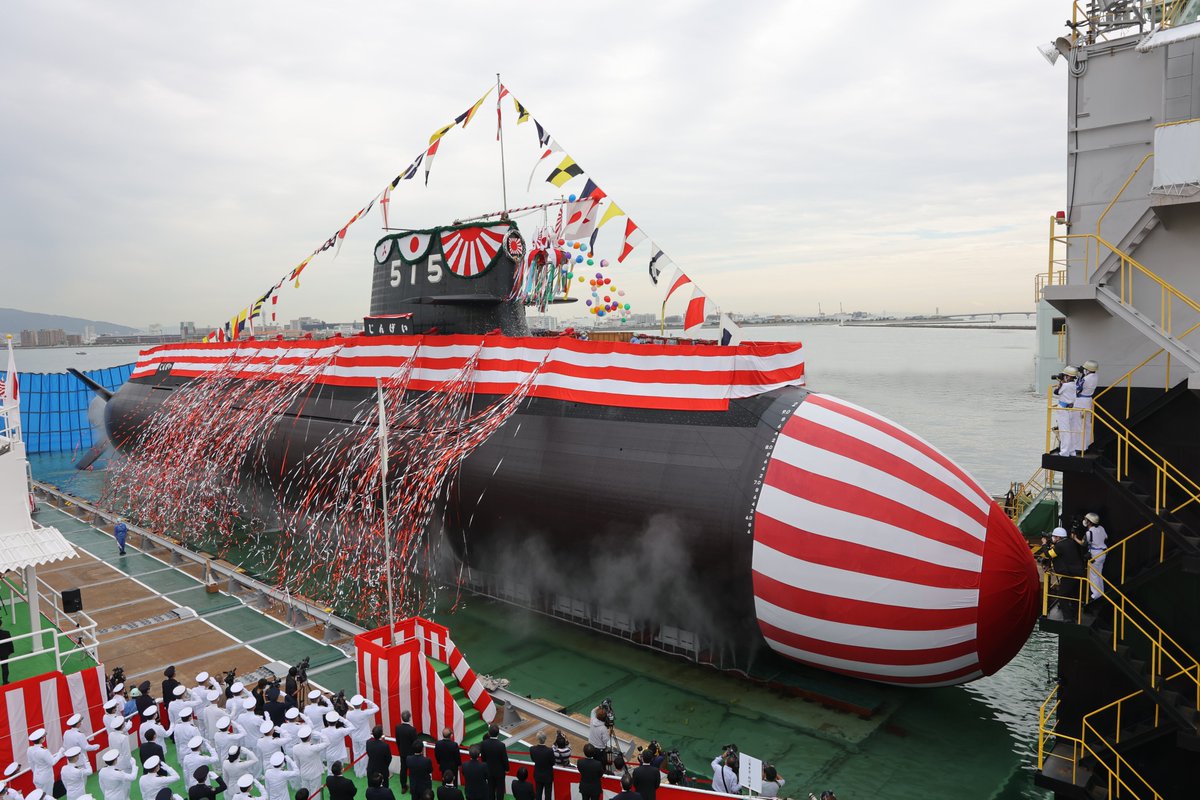
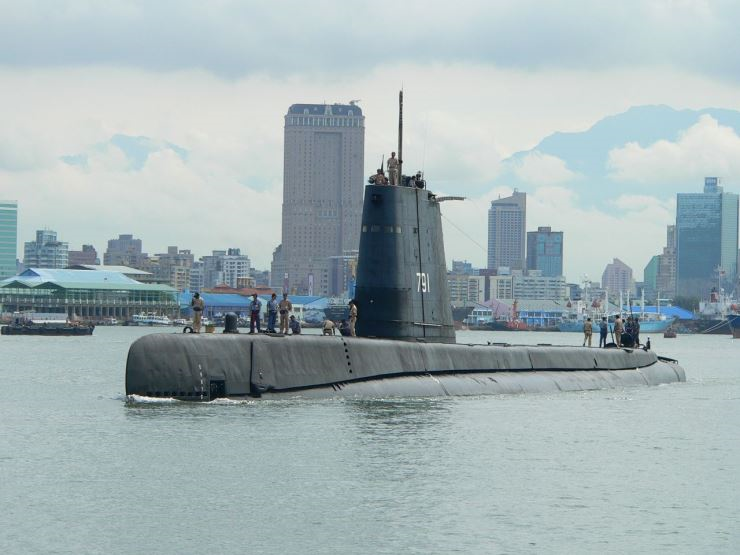
Even though Taipei appears full of doom and gloom over President Tsai’s electoral defeats during the recent local elections, future historians will study this ‘indigenous’ Taiwanese submarine project as an example of her administration’s success.
If the project proves successful, President Tsai and her team would have overcome decades – since the 1960s – of American, Chinese communist, China KMT interference and sabotage against a Taiwanese submarine fleet. No doubt rapidly shifting geopolitical realities enabled the change in American policy. This shift then brought along critical technology from other democratic allies, the UK, maybe South Korea, maybe Japan, and others. I remain fascinated and a bit confused at the relatively muted reactions from the Chinese communists and their allies inside Taiwan – is this because they have other problems and crises to deal with, or do they have other angles?
What remains true is this, if we compare the three democratically elected Taiwanese presidents, Lee, Chen, and Tsai – a bureaucracy of Taiwan’s central government, particularly the national security establishment, ensconced in decades of China KMT party-state external authoritarian occupation, a similar project under Presidents Lee and Chen that did not leak like a sieve would have been unimaginable. The relative success of the Tsai administration in preventing the vestiges of the authoritarian bureaucracy from sabotaging this project has been a noticeable success in Taiwan’s democratic consolidation.
As to whether or not these ‘indigenous’ (even a global empire like the US can no longer manufacture high-end weapons without global supply chains and know-how, much less Taiwan ….) submarines will deter and defeat a Chinese invasion – are eight enough? Should they be paired with unmanned underwater vehicles? Should they be armed with defensive and offensive ordinances? Are they linked with other Taiwanese military units as well as US and Japanese units? Maybe the first step in a genuine democratization of the Taiwanese military is to have an open national debate on why the Taiwanese Navy has been circling in step since the 1990s – unable to match the surface nor subsurface fleets of the region? In this, I suspect advice and know-how from American and Japanese officers will play a critical role in ensuring the money invested in hardware such as submarines will be properly deployed during a future war to defend Taiwanese sovereignty and democracy – a kind of AUKUS+ regional submarine chain – Australian and Japanese long-range submarines plus smaller Taiwanese and others to contain the China threat. This is also where the significance of the US NDAA is never about money or hardware/weapons per se, but the infusion of American expertise into the stagnate and reactionary Taiwan national security establishment. 27.12.2022
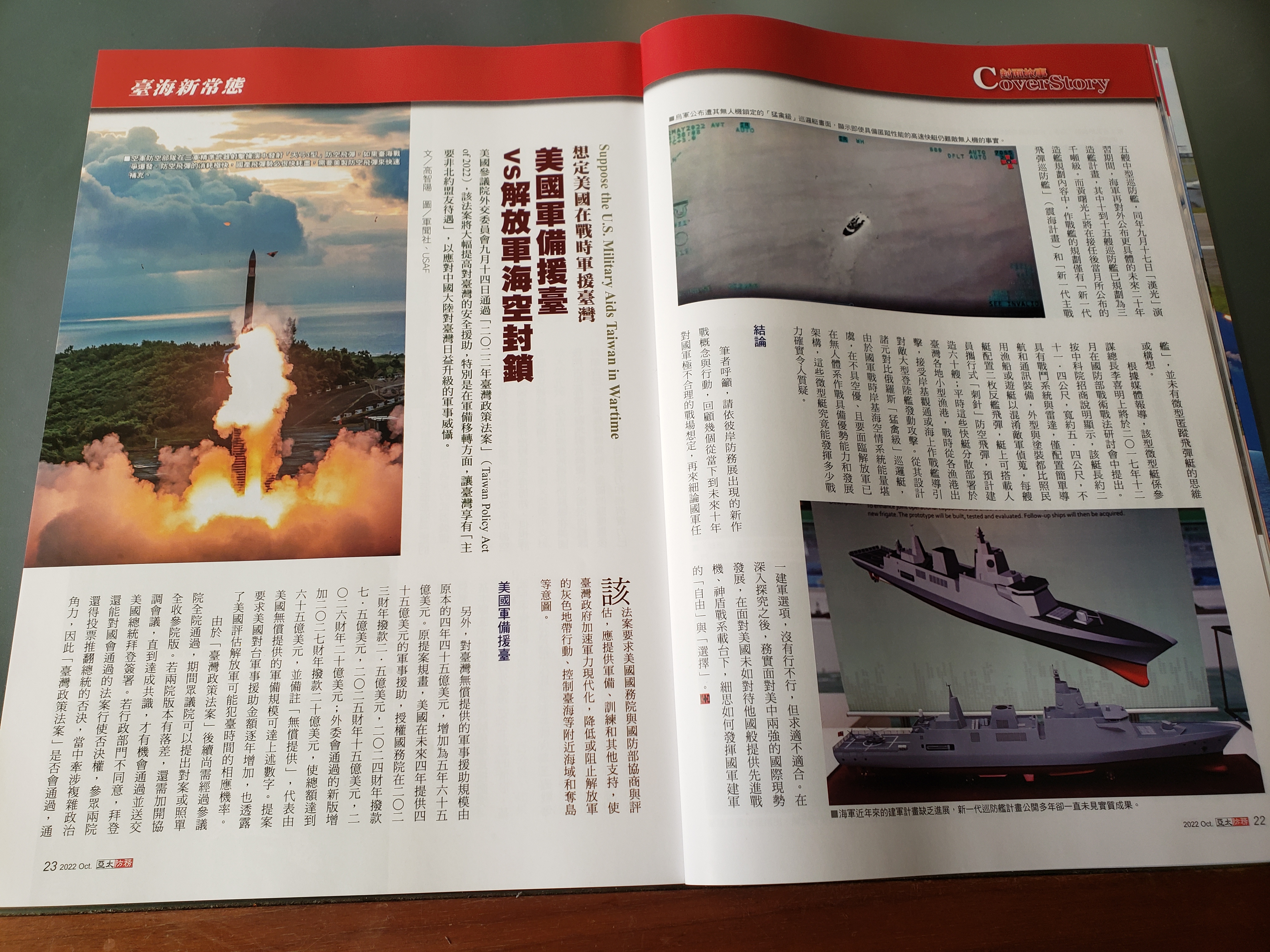
While the headlines and focus will be about the amount of US military aid to Taiwan Republic, and the weapon systems transferred, to me this is the most significant breakthrough in this year’s NDAA. Ten American officials per year to Taiwan is not significant – the mental-psychological breakthrough on the part of DC – the real pivot to the Indo-Pacific, understanding the China threat, and realizing the nature of the Chinese threats against democratic Taiwan – those are decades in the making. And one suspects once the breakthrough occurs, more will (and should) follow.
Even just the simple yet monumental step of normalizing the interactions between these two democratically elected national governments of America and Taiwan – official to official, bureaucracy to bureaucracy.
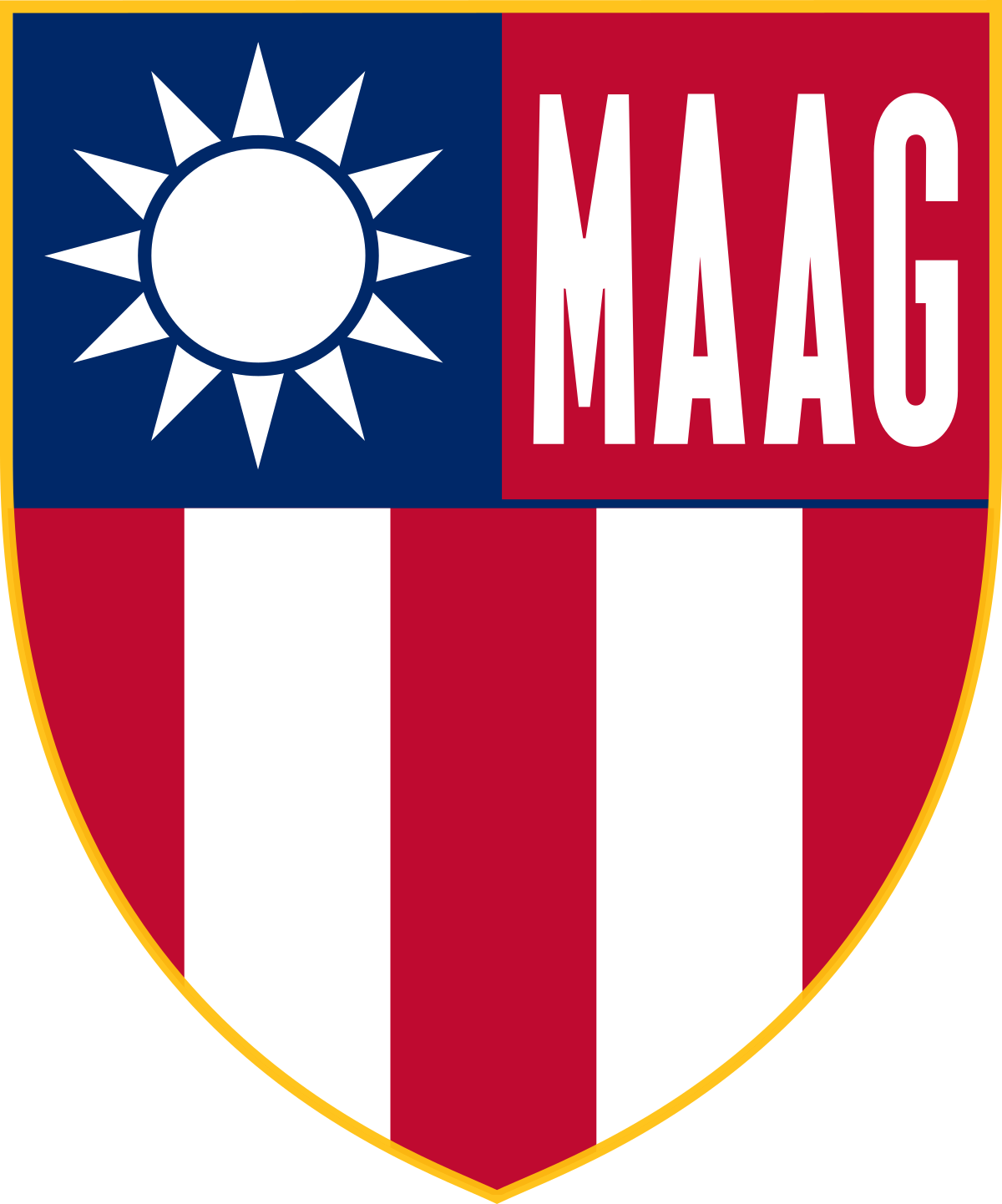
If the billions in direct military aid authorized by the NDAA are funded, and if the Biden administration does not waste more time fighting Congress, then I would expect more American advisors and officials to follow that money. I cannot find a previous case where Congress authorized large military foreign aid without request from the foreign party – nor was such an amount being transferred without direct US involvement (advisors, etc.) Because humans always refer to the most recent historical experience as a template, I have read many articles referring back to the US-RoC Mutual Defense Treaty/US Advisor era. Times change, the nature of the governments are different, and characteristics of modern warfare shift – the era of large contingents of US and Japanese troops stationed in Taiwan makes little sense. Rapidly rotating in units for realistic training and coordination – advisors in key units, teams from the US and Japan to help locate and fix weakest links in Taiwanese strategic and tactical planning, intelligence and counterintelligence, logistics, civil defense, sabotage, and infiltration, etc., in 2023 these will make more difference to the security of the Indo-Pacific and countering the China threat than anything else.
Have we ever had a case in American history where a designated aid nation did not request aid, and US Congress generously, voluntarily provide such a massive amount? And instead of debating whether this is good policy, perhaps the first prudent thing to do is to ponder what is going on in this moment of world history that such an unusual move has been taken.
Novices and bad actors will focus on the dollar amount, while experts and those with a sincere desire to protect democracy in the Indo-pacific will notice that the direct military aid is only the tip of a very large spear against the China threat — technology, education, trade, democracy, law enforcement, intelligence, and counterintelligence, etc. are other realms where this global struggle are occurring.
The most important part of the NDAA is Congress forcing a lumbering executive branch to pivot to face the China threat for real — i.e., increasing production of critical munitions, money for base protection, a stockpile of critical munitions in the region, etc. Novices and bad actors will focus on allegedly “provoking” the Chinese communists and rising tensions even though the communists are experts at self-provocation — they will fuss about budget and deficit, and they will spread lies that the Taiwanese prefer to surrender. Experts from this point on will avoid focusing on weapons sold and transferred, and see if Congress is able to force the executive branch and the Pentagon to do real interoperability — i.e., to abandon the idiocy of Jimmy Carter and invite the Taiwanese military to participate in US-Japan-Australian-NATO exercises. I wonder, and this is speculation on my part – would the US government voluntarily grant this massive amount of foreign military aid without sending American military advisors? Taiwan’s archaic and dated military leaders require a push and a nudge re: modern warfare – rapid pace, technology-centered, intelligence-counterintelligence, modern logistics, and creativity. What the Taiwan military leadership requires most, and perhaps this is where American, Japanese, and European advisors can best provide, is the lesson of Ukraine – a national military divorced from the democracy of its nation cannot and will not fight. Taiwan’s national security establishment requires democratization so that it can absorb and adhere to the strengths of the democracy it is suppose to protect.
I am against large US military presence in Taiwan, having nothing to do with the easily hurt feelings of the Chinese in China and the Chinese in Taiwan — but that it makes little tactical and strategery sense. Quick and thoughtful public and routinized rotations of American and Japanese units in and out of Taiwan to work on interoperability and training, with a small officer-advisor corp in Taiwan as advisors to the Ministry of National Defense and Taiwan’s democratically elected civilian leaders, and massive munitions and platforms depot in the area ready for the fight immediately are hopefully enough to deter the communists.
Now that the American aid is here, Taiwan must increase its annual war budget by the same amount — we have to increase our war budget so that our American congressional allies will have cover from domestic bad actors, united front fellow travelers. All multinational policies regarding the China threat is to prevent Beijing from even considering starting a war of annexation against Taiwan.
A history of why the Taiwanese Navy, in 2022, is still using two World War Two era GUPPY II conventional submarines would be a fascinating book – covering dictator Chiang Kai-shek’s delusional dreams of recovering his fictional China, to US Cold War policies, to misguided US policies on offensive versus defensive weapons, to the complications of Taiwanese domestic politics during the democracy era, that one of the two major political parties – the China KMT – has a national identity crisis (and hence, blocked the conventional submarine project for a decade.)
For a leaky Taiwanese national security scene, I have been impressed with how tightly the Tsai administration has held information on this ‘domestic’ submarine project. The fewer leaks the better, not just for the submarines project, but a sign that systemic problems in the national security apparatus are being fixed. While there were rumors of South Korean, or maybe Japanese involvement, recent reports indicate that the US and UK are the primary actors – with the recent British parliamentarians visiting Taipei indicating that discussions were held re: the submarines most interesting. A kind of soft AUKUS+ emerging – nuclear submarines for Australia and maybe Japan, conventional submarines for Taiwan.
What remains missing, I think, is a discussion-debate inside Taiwan, and then between Taiwan and its democratic allies, on an overall strategy to deter and defeat the China threat. Are eight submarines enough? Should they have offensive cruise missile capabilities? Are the submarines designed to operate with CSIST’s mini/unmanned underwater vehicles? Are they designed with interoperability with the Japanese and American Navy?
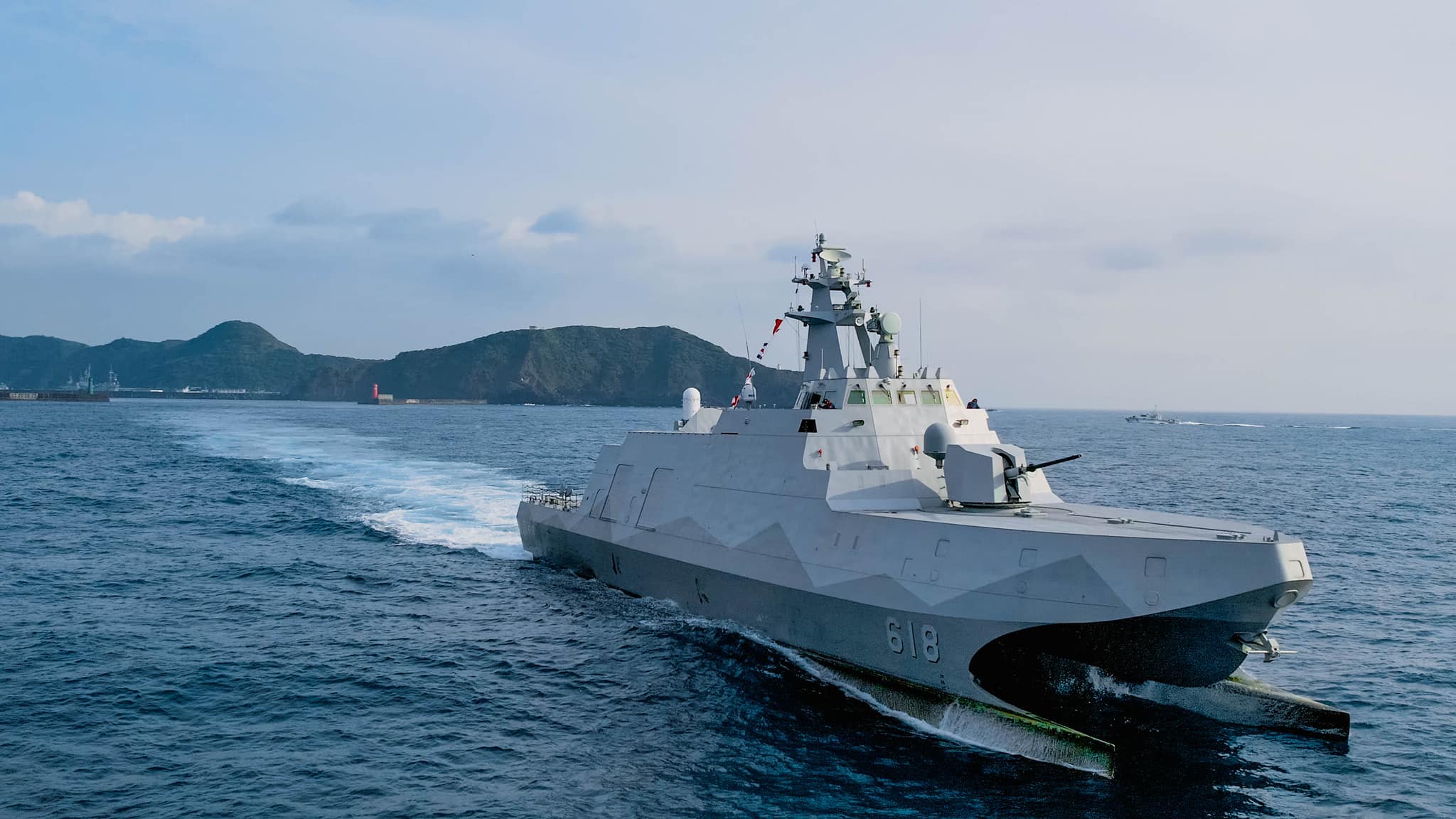
Taiwanese shipbuilder responsible for its double-hulled fast attack corvette has signed an MOU with Lockheed Martin for Taiwan to build the hulls while Lockheed Martin coordinates and fits their weapons and sensors. These small naval ships will be sold to Southeast Asian nations. The fact that usually hypersensitive to Beijing’s opinion Southeast Asia may be involved is fascinating. If this deal proceeds accordingly, this is good news for Taiwanese and regional security – anything which further integrates democratic and independent Taiwan into the US-Japan-led global democratic supply chain is good. Not clear if this is a part of the purposeful news leak from the latest Taiwan-US military summit where the US plans to collaborate on weapons manufacturing. Also, a very good sign that a civilian, nonstate-owned Taiwanese shipbuilder is involved in this deal. Previous plans to integrate aviation and aircraft maintenance with global arms suppliers faced stiff resistance from Taiwan’s archaic and complicated military-state (and formerly, authoritarian China KMT party) owned enterprises. Israel, South Korea, and Singapore are three good models of small-mid sized nations surrounded by larger hostile powers, and how they have focused their resources and rationalized the collaboration between military-state led R&D, civilian corporations and manufacturing, and links to global military supply chains.
An important part of Taiwan’s democratic consolidation is to push into the last mile – the national security apparatus is the most resistant to democratic change and modern transformation. This is also the sector where modern management techniques and manufacturing would go a long way in aiding Taiwan to modernize its own domestic arms manufacturing. As the Russian invasion of Ukraine has demonstrated, even a global superpower like the United States cannot manage the logistical challenges of a modern medium-intensity war alone – so it serves vital American national security interests to coordinate with global democracies such as Taiwan, Japan, Korea, EU partners by creating a global arms supply chain. We hope for peace of course, but any potential democracies versus authoritarian China conflict in the future will be far more intense than the Russian invasion of Ukraine. The ability of the US, Japan, Taiwan, and democratic allies to restock high-end high technology munitions (THAAD, Patriots, AMRAAM, etc.) in a high-intensity war will play a critical role in any future conflict in the region. 24.11.2022
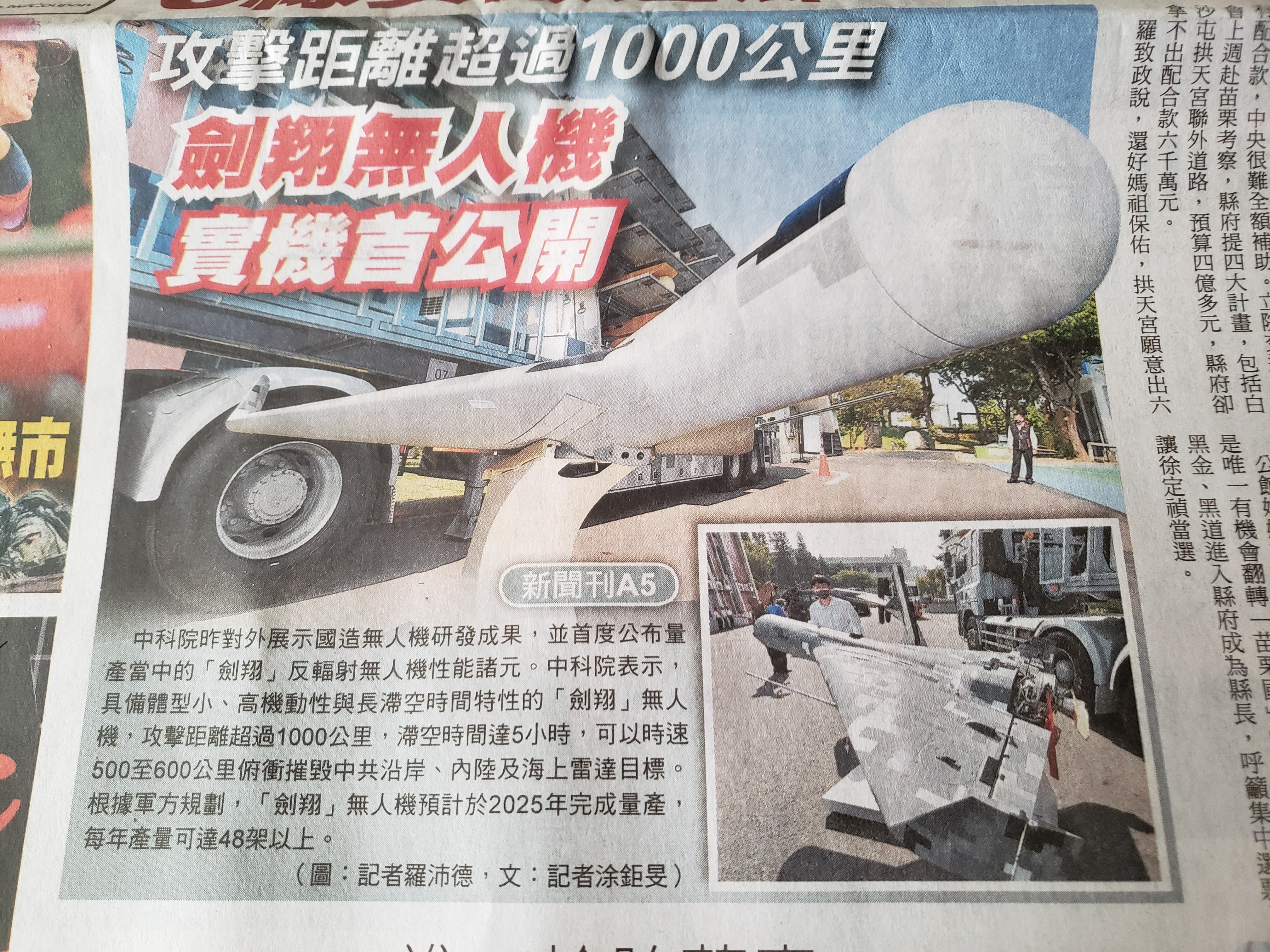
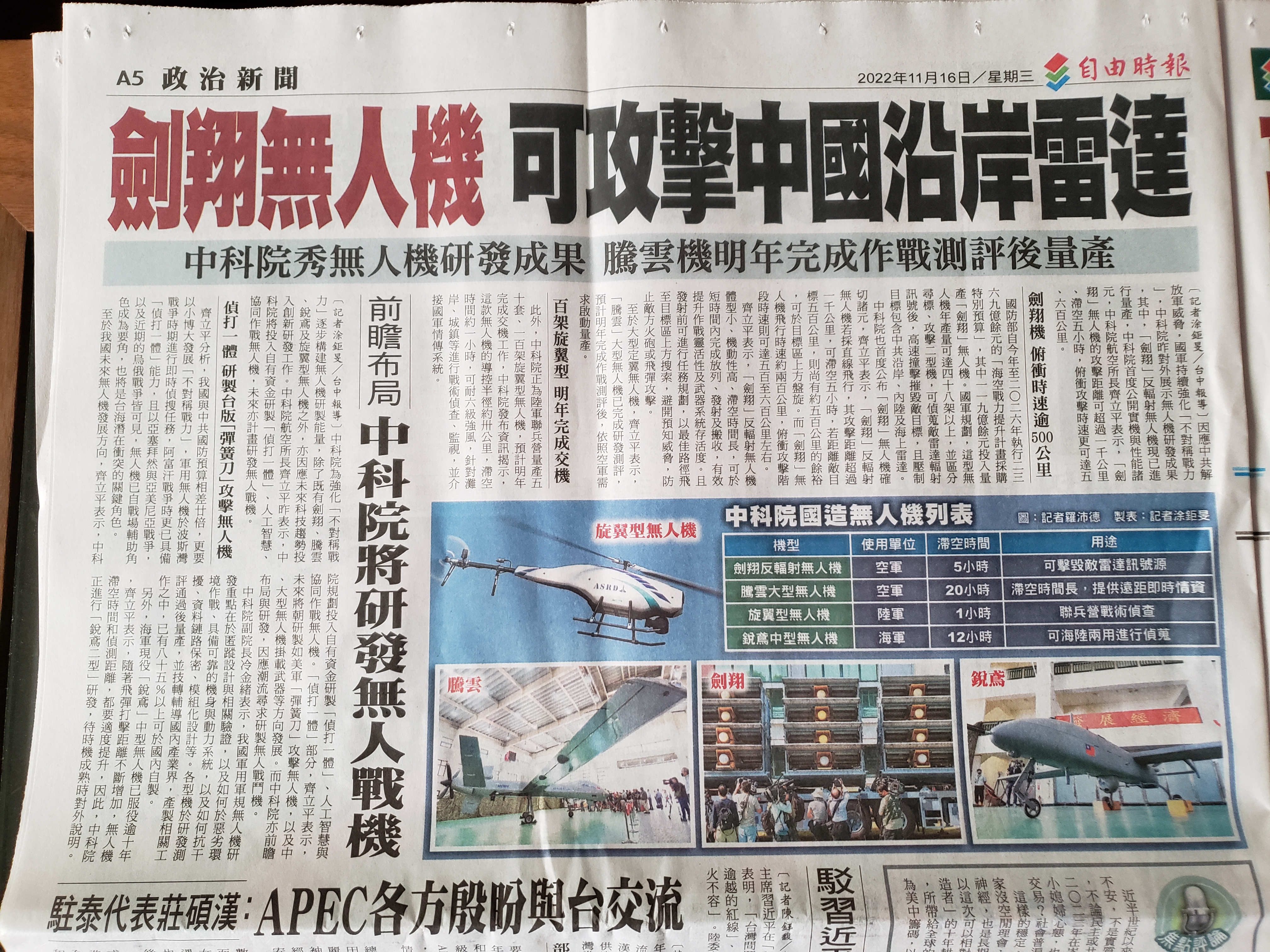
Taiwan’s Ministry of National Defense is at least two decades late in terms of unmanned vehicles – in the air, at sea and submersed, for coastal defense. The gap between Taiwan’s vibrant and creative civil society – economy, commerce, technology, innovation – and its national security establishment cannot be wider than in the UAV sector. And I suspect while the obvious gaps are in the hardware, the greater threat to Taiwan’s national security exists in the ‘software’ – strategy, tactics, openness to new ideas, thinking creatively, and learning from the world. The Chinese communist military has invested decades in unmanned technology – the Taiwan Ministry of National Defense is still discussing bayonets. This Ministry of National Defense is reactive, conventional, and prefers copying past practices, refusing to learn from global counterparts such as the Israelis. A Martian traveling to earth in the 1990s and assessing the balance of power between communist China and democratic Taiwan, would surely assume smaller Taiwan would focus its energy and attention on unmanned vehicles. That it is 2022 and Taiwan’s national security apparatus has barely just started – much less engaging its talented civilian sectors in a wide-ranging discussion of strategy and tactics, is astonishing. Though, better late than never.
There are other public policy discussions a democratic nation such as Taiwan should engage in. The role and purpose of CSIST, for example – should it focus on R&D and subcontract the manufacturing to civilian firms? Should it try to engage R&D in all sectors as it appears to do now? In what ways can CSIST play a leading role in placing Taiwanese high-technology manufacturing into the global democratic supply chain? If Taiwanese civilian firms have an edge on CSIST in UAV technology, what are the global best practices to ensure the talent and creativity of the private sectors are harnessed while maintaining national security? As Admiral Lee and others have rightly argued, Taiwan’s democracy requires open and honest discussions and debates on its national security options. 16.11.2022
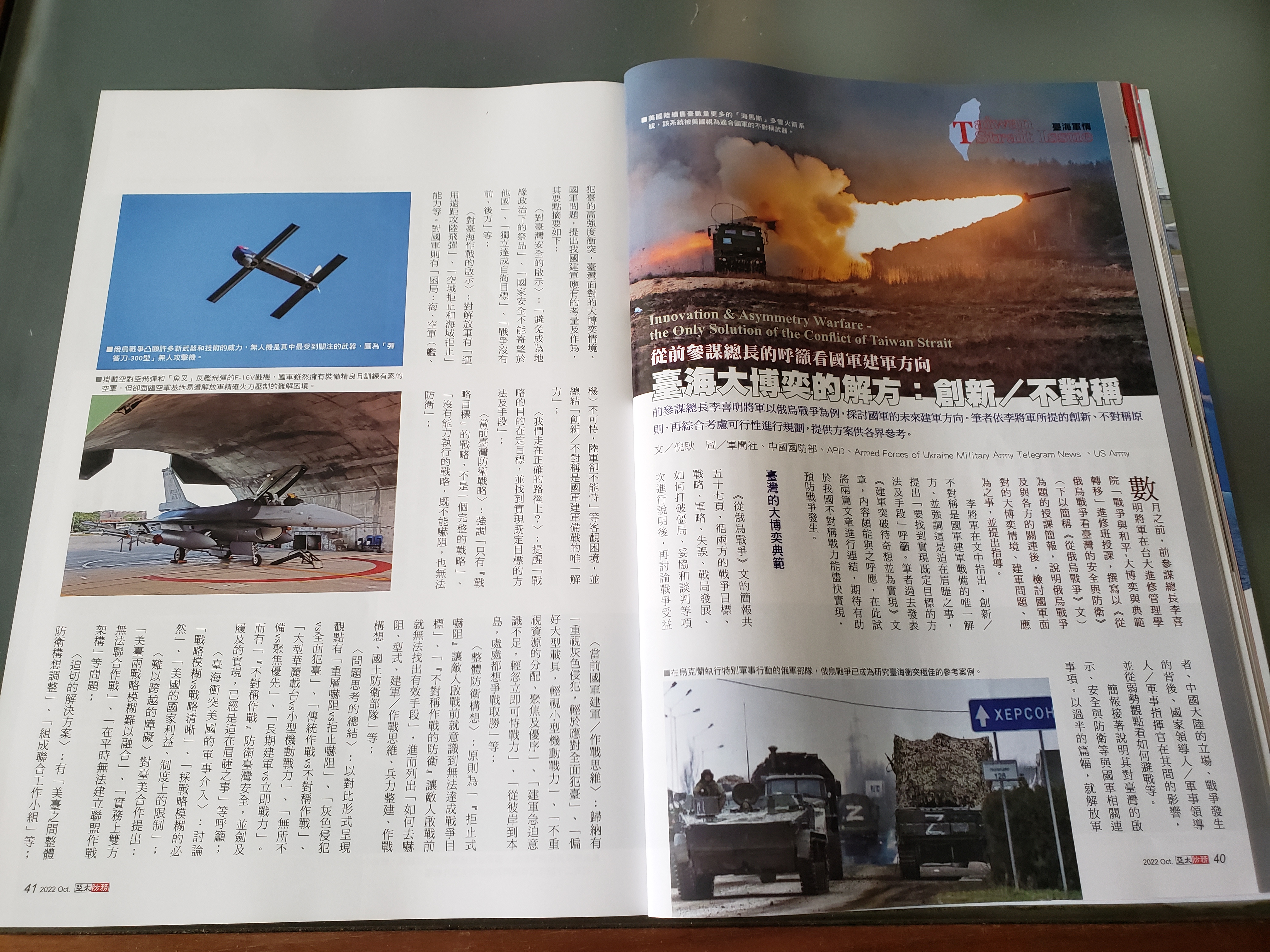
Admiral Lee’s main argument is that smaller, resource-poor Taiwan’s best defense policy is to transform its national security establishment’s long-held mentality and focus on smaller, mobile, survivable platforms-munitions in all branches while emphasizing resiliency, mobility, and survivability in surveillance, intelligence, and logistics. These are difficult changes because they revolutionize how things have been done within the Taiwan Ministry of National Defense since 1949. These proposals also revolutionize how the nation’s elected leaders and citizens evaluate their national security and express their sense of national pride – pouring concrete and making small mobile communication vehicles and producing thousands of cheap, replaceable drones make national security sense, but challenges the psychology and emotions of all sectors of this nation.
Which gets us to the mystifying process of how the Taiwanese Navy has been pursuing its surface fleet since the early 1980s. I am not a partisan in intra-Taiwan Ministry of National Defense factions and arguments – I find those arguments, dating back to their China days (big northern fleet versus small attack craft southern command ….) tiresome. It is fascinating to think carefully about Admiral Lee’s stillborn manned and unmanned stealth missile crafts versus recent news that once again the Taiwan Navy will reverse course, delay its larger AEGIS/VLS surface vessels, and build smaller non-AEGIS/VLS frigates.
I do not have the professional-academic background to argue which model makes the most sense. Whether Taiwan is better off with a large vessel fleet, small fast attack craft fleet, a combination of both, and/or focus on submarines (and if so, what size and how many ….) I do have the background to conclude that Taiwan has not had an adequate, democratic, public policy debate over such an important issue. Admiral Lee’s argument is that if the US warning that dictator Xi and the Chinese communists want to be ready for a war of annexation no later than 2027 – then quickly getting hundreds of small, cheap, rapidly manufactured missile crafts into service is far more sensible than programs requiring decades. He further makes the argument, convincingly, that the Chinese communists would like nothing more than a grand, conventional, force-on-force battle – reminiscent of how Chiang Kai-shek’s army melted into thin air in 1948-1949 China I think.
And if these smaller frigates take too long to build, require too many sailors to staff, take too long to train to bring online, and are too easily sunk by the Chinese – well then in the same issue of this Taiwan-based military magazine, the additional mystery of Taiwan Navy building a massive amphibious landing vessel. In an ideal world – say if you are cheating in a computer game and money can be infinitely replaced, then sure you buy everything. In the real world, Admiral Lee argues correctly, one needs to prioritize – and the priority is not choosing weapons that make people proud, but choosing weapons that will survive the initial strikes from China and be able to inflict enough damage on the invaders so as to deny them the victory they seek.
But then the peculiar modern history of Taiwan is this. In the early 1980s when Taiwan was still under China KMT martial law military publications began to appear, but military affairs were very much seen as highly confidential, only the military ought to discuss the military. Taiwan has a long history of civilians rightly avoiding politics, military, history, and diplomacy – no one wanted to become yet another political prisoner of the China KMT. This is what I thought of when Admiral Lee pointed out Taiwan is one of the world’s leading manufacturers of high-end speed seacrafts – one of many, many areas where the democratic, civilian Taiwanese civil society thrives, yet this historically created chasm between the national security establishment and Taiwanese civilians remain. In this sense, the greatest proposal from Admiral Lee’s book is not about a particular model or approach, or a particular weapon or munition – I’ve noticed in publications and online discussions these shorthands, asymmetry, porcupine, Javelins and Stingers. I think the main conclusion from Admiral Lee’s book, and the experience of Ukraine, is that a democracy cannot compartmentalize its national security policies from other realms of democratic policy debates. That in order for a democracy to make difficult national security decisions, in order for the democracy to harness all of its talents, its national security apparatus must be as democratic and modern as the rest of the nation. Admiral Lee pointed to the thriving and creative ship design and building industry in Taiwan – contrast that with the uncreativity and directionlessness of the Taiwan Navy since the 1980s. I see similar gaps in unmanned vehicles (design, manufacturing, deployment-uses), in gaming, in information warfare, etc etc. Taiwanese businesses are perhaps some of the most creative and resilient in global logistics – whereas the Taiwan military has had a reputation for weaknesses in logistics. Democratizing and modernizing the national security establishment are the only ways forward to ensure Taiwan’s national security can withstand the challenge posed by its imperialistic autocratic neighbor.
This is an important book regarding the national security of Taiwan, and it is a pity that it has provoked little earnest discussion and debate among Taiwan’s civilian and military leaders. This does not mean I believe Admiral Lee’s ideas should all be adopted – but the lack of debates is indicative of the greatest danger posed to Taiwan’s national security – the inability of its hyper-conservative (in this instance, I mean not ideology but a culture – reluctance to embrace new ideas, take risks, debate openly) national security apparatus to adopt democratic and modern norms in order to make necessary and rapid adjustments.
At nearly five hundred pages, this book could have used more thorough editing. The writing can be repetitive. In a polarized national identity climate, nothing in public policy Taiwan can escape quick and ideological dismissals. Probably I disagree with Admiral Lee on most political and diplomatic issues. I respect his expertise, and I see no reason as other reviewers have, prematurely jump to conclusions regarding his patriotism and loyalty.
If I were to choose a few pages as a microcosm of what makes this book important, it would be the section on Admiral Lee’s proposed manned and unmanned stealth mini-attack naval crafts (pages 344-357). Many words have been spilled by many parties over this aborted proposal – but the admiral’s convincing explanation here, and the unhealthy political process by which other leaders in the Taiwan national defense establishment ended this project without engaging in a proper and fair democratic debate, serves as an important example for what policymakers in Taipei, Tokyo, and DC ought to focus on – not merely weapons and platforms, not how much money to provide for military aid, not denial versus control, not porcupine or not – but that Taiwan’s military leadership is in dire need of a revolutionary change in culture.
Elsewhere I have noted this, that in the decades of Taiwanese democratization, the national security institutions have been the least touched by democracy and openness to engage the rest of the world. One may generally argue that this is the case in most nations. Yet I think one can reasonably argue that this phenomenon is particularly pronounced in Taiwan. And Taiwan’s civilian leaders from all parties lack the expertise, and rightly fear the instability of a menacing authoritarian neighbor, by pushing for democratization and openness within its military.
This is where a constructive avenue is to adopt the models of the 1950s, where Taiwan turned to Japanese and American officers – retired and active service – for advice. Again, refusing to participate in simpleminded name calling one sees in some Taiwan-based military publications – this is not about whether Taiwanese officers have expertise and insight. I think they do, no less than foreign officers. I have never had doubt about the quality of the Taiwanese rank-and-file military – only doubts and worries about its generals and admirals. The problem is not expertise, but bureaucratic, institutional inertia, decades in the making – requiring a push from the outside to cut through decades of habits and precedence. In many ways while reading this book and other related articles the inertia in the Taiwanese military leadership reminds me of the American higher ed thought leaders – everyone knows a demographic tsunami is coming, everyone agrees that the economic model makes no sense – yet there is zero incentive structure for anyone to be the one to say this, much less to make substantive changes.
So then back to Admiral Lee’s mini-missile crafts. I do not have the expertise to decide whether they were the right approach for the defense of Taiwan. I think the fact that there was basically no national discussion and debate, from the proposal, and adoption, to the removal of both the policy and Admiral Lee himself from office, illustrates the gap between Taiwan’s democracy and its national security policy-making apparatus. Even the fact that this book has received relatively muted responses from Taiwanese political leaders, military establishment, journalists, and scholars, illustrates this dangerous gap – an otherwise vibrant democracy, yet cannot engage in honest and direct conversations and debates regarding its fundamental survival.
And I admit, as I read Admiral Lee’s thorough proposals, moving away from jet aircraft and large warships and armored vehicles, my initial reactions were emotional and reactive – my decades-long sense of Taiwan’s national defense and identity intertwined in these weapons and systems. Yet Admiral Lee’s analysis is rational and thoughtful – how does a smaller nation invest very limited resources so that it could deny a larger neighbor the military victory it seeks? And Admiral Li is a rare Taiwan military leader who is neither defeatist/too political, yet is willing to risk the unpopularity of speaking the unvarnished truth.
This reminds me of something I have thought about for decades as I watch Taiwanese military maneuvers and read interviews and articles published by the Taiwanese military – a core question for me has been: Are these generals and admirals honestly preparing to fight for real? And I think Admiral Lee has convincingly answered this question as sadly being no. This is where Taiwan’s civilian democratic leaders require the most assistance from their US, Japan, and other democratic allies – expertise and credibility to push for a revolution in Taiwanese military leadership. A few recent examples are alarming indications. That the Taiwan military leadership reacted so slowly to the Chinese communist unmanned aerial vehicle intrusions is a clue of deep-seated institutional problems. The recent special forces maneuver preparing for a Chinese communist landing at the mouth of the Tamsui River – they have been practicing against that scenario for as long as I have been reading the news – do you suppose the Chinese communists have noticed that too? And if so, why would they follow the Taiwan Ministry of National Defense’s scenario? And finally, this is subtle but to my thinking indicative and fundamental. A Taiwanese college student, a music major, on his own initiative used open-source information to map out major Chinese communist military installations on Google Map. In most functioning democracies he would have been invited by the Ministry of Defense – if only for the PR/marketing/recruitment drive – and an even smarter military would see this as a way to draw strengths from the democracy it is trying to protect. Yet thus far, to my knowledge, the Taiwan Ministry of National Defense has not reacted.
This is where Admiral Lee’s policy suggestions should meet actual global policy moves. All of the particulars he has offered are debatable in a democratic process. I think one of the most important first steps for Admiral Lee’s proposal to have a chance of taking root inside Taiwan’s national security institutions is for a US-Japan led global effort to share expertise – civil defense and modern military concepts by Finland, Sweden, and Norway; logistics and civil defense by Israel; how to modernize the Ministry of National Defense by the US. And perhaps a pressing issue is to find ways to send Taiwanese and American officers to learn from their Ukrainian counterparts. How did Ukraine manage to transform its authoritarian, Soviet-based national security apparatus to adapt to its modern democratic reality? How did Ukraine manage to deal with members within its national security apparatus who had loyalty-identity issues without violating democratic norms? How did Ukraine manage the vast logistical and supply issues [recent Taiwan military publication rightly focuses on this issue – where will foreign military supplies reach Taiwan during a war? Has Taiwan planned on how to move them from air and sea ports to storage and distribution?] What lessons have the Ukrainians learned regarding the resiliency of local governments, police, reserve forces, transportation, and communication?
Taiwan has had a long history of sending officers and fact-finding teams abroad, similar to those US higher ed task forces and committees, where findings and reports sink slowly into an entrenched bureaucracy full of reasons why needed reforms cannot occur. Taiwan Can Help, Taiwan in military affairs needs that push from abroad – expertise, resources, reassurances – so that it can transform its mentality from fielding a force for the parade grounds, into a military force prepared to fight, prepared for the unexpected. Admiral Lee has provided invaluable service to his nation by writing this book – a thankless task really, he could have easily kept his mouth shut, become the head of another state-owned industry, and collect his pensions, he should have the gratitude of everyone who cares about Taiwan’s democracy. 12.11.2022
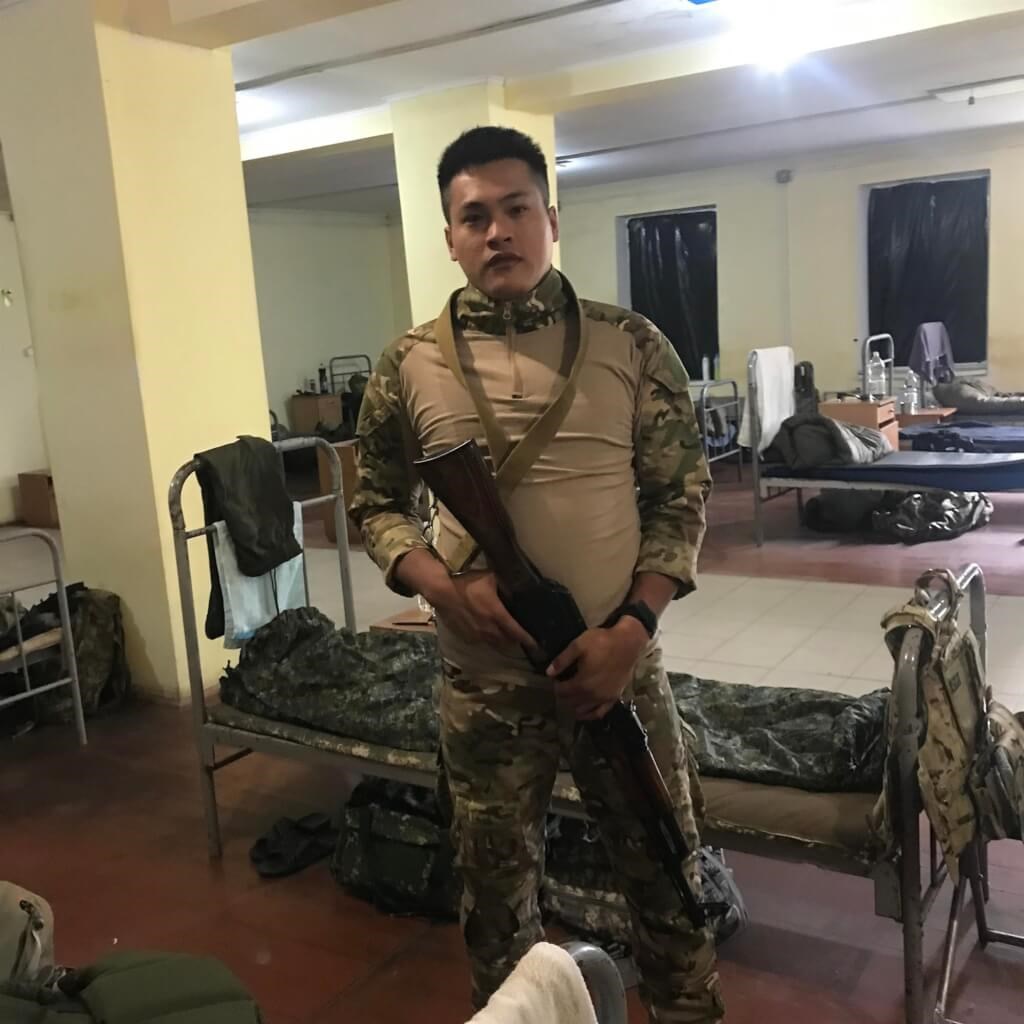
In a world full of cowards, only a few heroes emerge. Something I tell students often — when assessing actions of historical figures and others, we tend to imagine a utopian standard for ourselves — surely we would face down the Nazis, of course we would risk jail or worse when the Chinese communist tanks rolled in the streets of Beijing, we would never ponder our livelihood by ratting out friends to the China KMT dictatorship — this is not making excuses for evil acts, just a caution that while watching films and reading novels we like to transpose ourselves as the hero, in beliefs in previous lives somehow we are almost always prince and princess and never dirt poor peasants, yet in reality, most of us do not make the cut. We are not rockstars. We are average, and fallible. A more cautious, realistic, humble view of human behavior — whether in warfare or in everyday life.
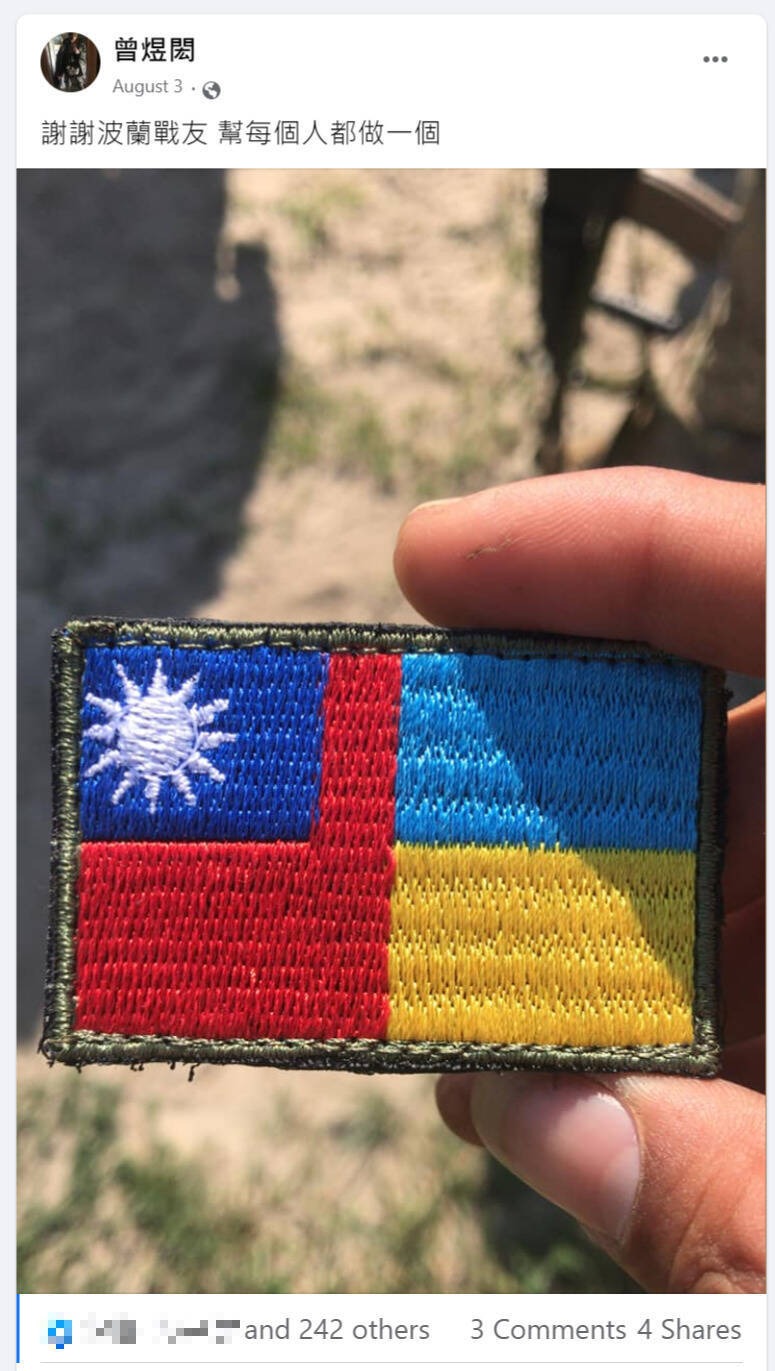
All a long-ish way to pay tribute to this fallen Taiwanese hero — most of us will think and talk and feel behind our phones and keyboards, and few of us will get on a plane, pick up a gun, and kill and die for democracy. Taiwanese hero Tseng’s criticism of the Taiwan military leadership excerpted above should not get lost, either, it is nothing new – Taiwan has sent hundreds and thousands of talented young women and men abroad to study modern military doctrines, only to have them return and get chewed up by the China KMT national security apparatus. The best way to honor his memory is to take these ideas to heart and engage in difficult reforms of the Taiwan national security establishment.
This slowly emerging, complex modern Taiwanese national identity based around democratic sovereignty is another way to honor his sacrifice, and it relates to Taiwan’s pandemic slogan Taiwan Can Help. The China KMT dictatorship brought to Taiwan a contradictory identity – at once self-pitying (refugees forced to a barbarous hinterland island, dependent on American generosity and Taiwanese tolerance but unable to face this embarrassment directly ….) and arrogant (“we” are the real China, the cream of the crop, “we” brought the gold and high culture and the essence of real Chineseness to you lessers ….) One sees a microcosm of this pitiful interplay among the Taiwan national security press – the inaccurate often repeated myth that the Taiwanese defense industry would have made world-class weapons had it not been for American manipulation; one still sees the China KMT legislators at parliament asking whether foreign nations will come to Taiwan’s assistance when the Chinese communists attack.
A slow but significant transformation in democratic Taiwan, and a significant feature of this emerging Taiwanese national identity, is to normalize this democratic nation by stepping away from this self-pitying/arrogant prison brought by these outsiders. Taiwan, as any democratic must, should not focus on who will help during an invasion but must focus on what we must do to defend ourselves. Taiwan Can Help is an important democratic and universal human rights principle – we are not beggars, we are a member of a democratic community and we have a duty to help others whenever we can. This principle applies domestically, and globally. A small detail I noticed when Taiwanese Vice President Lai briefly chatted with US Vice President Harris in Honduras – VP Lai did not ask VP Harris for anything, instead, VP Lai offered Taiwan’s assistance to US-led humanitarian work in Central America. A seachange in attitude from the China KMT dictatorship days.
May the Buddha bless this Taiwanese hero and his family, and may the Buddha protect Ukraine, Taiwan Republic, America, and all democracies.
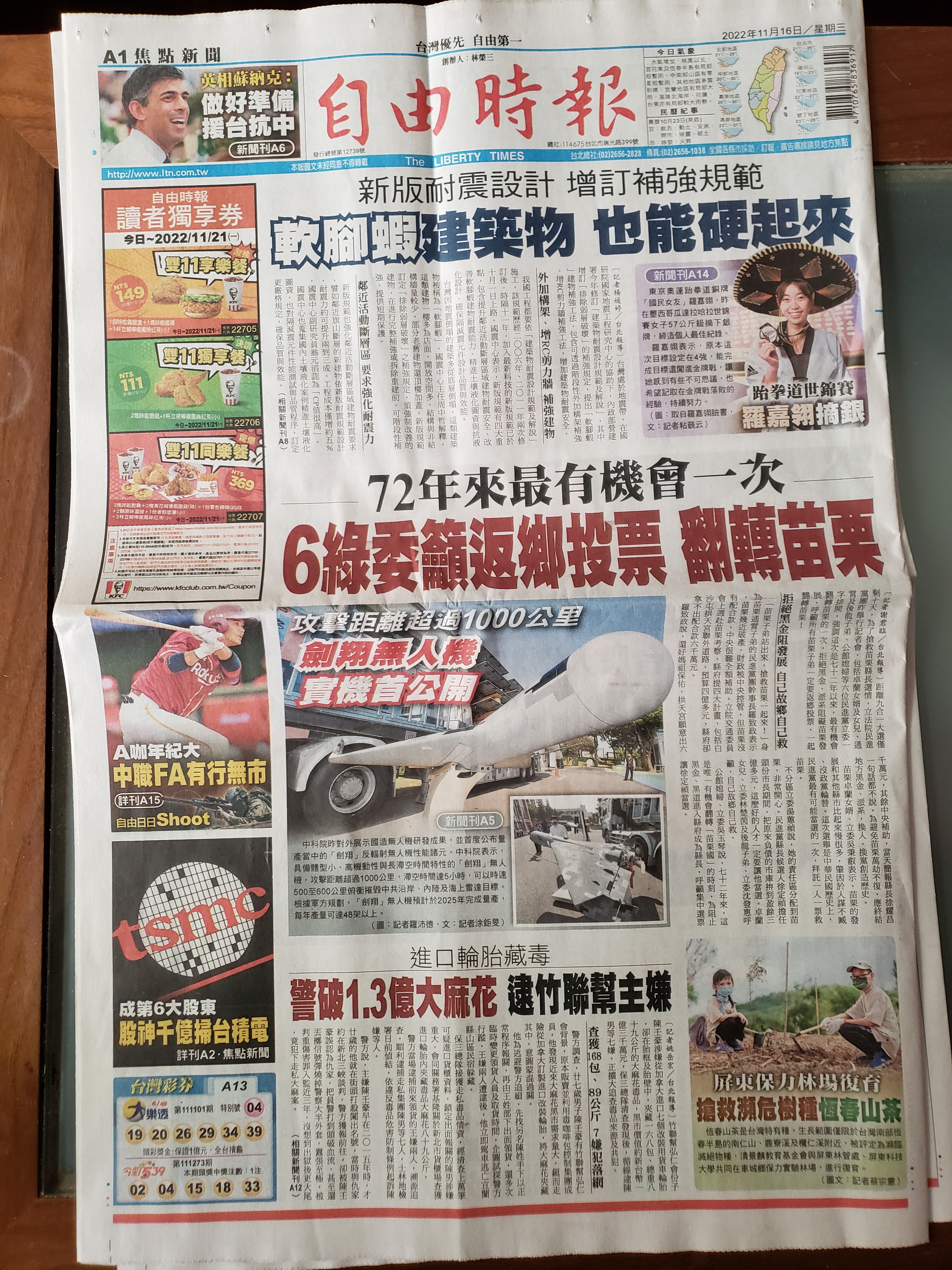
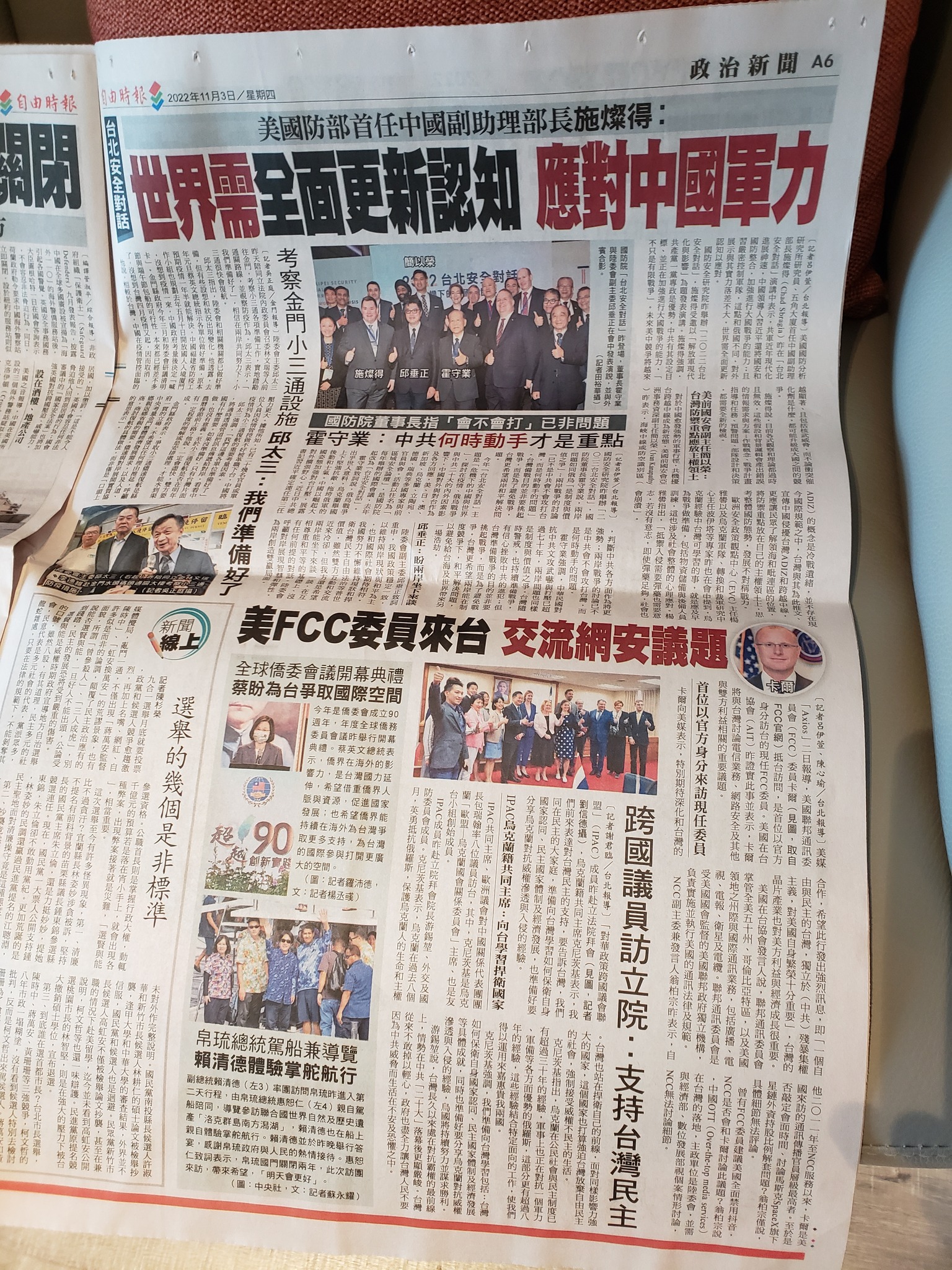
Taiwan news, Thursday (3/11/2022) print newspaper. Most important news is tucked away inside A6, I find the only print newspaper left in Taipei confusing. A global security dialogue took place in Taipei, a second-third track quasi-official conference full of leaders from the Indo-Pacific. That the focus is on the China Threat is not surprising. That a former US official called on Taiwan Republic to focus its resources to defend its soverignty is fantastic — this echoes President Tsai’s main idea, and is why the China communists-KMT and some American academics are staging such fierce information warfare against Tsai and Taiwanese democracy.
On the same page is the other significant news: the head of the American FCC is visiting Taiwan Republic to discuss cybersecurity. Taiwan Republic just established a Ministry of Digital Affairs and assigned their genius cabinet member Audrey Tang (part Taiwanese, part Vulcan) to head it. Remember the head of the Taiwanese FBI visiting the head of the American FBI? Then I pointed out that whether the Library of Congress style categorizing has the heading of hacking, cybercrime, industrial espionage, illegal drugs, or human trafficking, these are all spokes leading back to the Chinese Communist Party. And so once the Americans started counterattacks against the Chinese communists in semiconductors, then I am looking at ways the US will lead its democratic allies to combat the Chinese in financial, cyber, and other related realms. Taiwan is an interesting frontline beyond the obvious geography — China, HK, Taiwan, California — the movement of people, multiple passports, nationalities, know-how, capital — dictator Xi plugged up HK as a conduit to strengthen (temporarily) his dictatorship, the US, in turn, shows up in Taiwan Republic with FBI, DEA, Coast Guard, and Homeland Security. A multifront, all-domain, global struggle. 4.11.2022






 Taiwan in World History (台灣與世界歷史)